REALTOR 1031 EXCHANGE GUIDE
How Realtors Help Clients Find Replacement Property in a 1031 Exchange: A Complete Guide
When an real estate investor hands you the listing for an investment property, they are not just asking you to sell bricks and mortar; they are asking you to safeguard their capital gains. Under Section 1031 of the Internal Revenue Code, real estate investors can defer 100 percent of federal and state capital gains taxes, as well as depreciation recapture, by reinvesting their sale proceeds into like-kind replacement property. However, the entire tax-deferral strategy hinges on one brutal, unforgiving constraint: finding and formally identifying suitable replacement property within exactly 45 calendar days of closing the sale of the relinquished asset. Without a proactive, educated real estate agent driving the replacement property search, investors frequently run out of time, trigger massive tax liabilities, or settle for inferior assets. Real estate agents who master the mechanics of replacement property sourcing become indispensable strategic partners, unlocking double-commission transactions while protecting their clients' wealth.
IN THIS GUIDE
How agents keep the replacement search ahead of Day 45
Source early
Off-market outreach, MLS and commercial database alerts, and a ready lender network.
Identify correctly
When to use the Three-Property Rule, the 200 Percent Rule, or the 95 Percent Exception.
Prevent failures
Pricing panic, financing delays, inspection surprises, and uncooperative sellers.
Why Realtors Are Critical to 1031 Exchange Success
The role of a real estate agent in a 1031 exchange extends far beyond typical transactional guidance. In a standard real estate transaction, timing is flexible, and contract extensions are commonplace. In a 1031 exchange, IRS deadlines are fixed by federal statute and cannot be extended under any circumstances short of a federally declared disaster. Realtors serve as the operational engine that translates an investor's tax strategy into executable real estate acquisitions, ensuring that replacement assets are identified, vetted, and under contract before statutory clocks run out.
The 45-Day Identification Window and Why Speed Matters
The 45-day identification window begins on the exact date title transfers on the relinquished property. Day 1 is the day immediately following closing, and Day 45 ends precisely at midnight. Within this narrow timeframe, the investor must deliver a written, signed, and unambiguous identification notice listing potential replacement properties to the Qualified Intermediary (QI).
Because 45 calendar days pass extraordinarily fast—especially in competitive real estate markets—agents cannot afford to begin the search on Day 1. Elite realtors begin sourcing replacement property candidates weeks before the relinquished property even goes under contract. Waiting until the closing table to start searching leaves an investor with roughly six weeks to conduct market analysis, evaluate cash flow, perform preliminary physical due diligence, draft purchase agreements, negotiate terms, and secure initial lender pre-approval. If an unguided client fails to identify property by midnight of Day 45, the exchange fails completely, and the entire capital gain becomes immediately taxable.
Like-Kind Property Knowledge Realtors Must Have
One of the most persistent misconceptions among real estate investors is that "like-kind" property requires replacing the sold asset with the exact same asset class—for instance, exchanging a single-family rental for another single-family rental. Realtors must educate their clients that IRS regulations define like-kind broadly across real estate categories.
Under Section 1031, virtually any real property held for productive use in a trade, business, or for investment qualifies as like-kind to any other real property held for investment. An investor can exchange a residential duplex for an industrial warehouse, raw agricultural land for a triple-net (NNN) commercial property, or a suburban retail strip center for a multi-family apartment building. Understanding this broad flexibility allows realtors to help clients pivot into higher-yielding asset classes, transition from active management to passive income, or diversify across geographic regions.
The Core Responsibilities of a Realtor in the Replacement Property Search
Guiding an investor through the 1031 exchange replacement property search requires a systematic approach combining deal sourcing, statutory compliance checks, and cross-professional coordination. Realtors must act as project managers across the transaction timeline.
Sourcing Properties Within Strict Timelines
To successfully source replacement property within the 45-day window, real estate agents must maintain active property pipelines. Sourcing requires evaluating both active market listings and off-market opportunities simultaneously. Agents must analyze property cash flows, cap rates, net operating income (NOI), and potential capital expenditure requirements rapidly.
Furthermore, agents must ensure that replacement candidates meet the investor's debt and equity replacement requirements. To achieve full tax deferral, the investor must purchase replacement property of equal or greater total net value than the relinquished property, and reinvest all net cash proceeds. If the relinquished property had $500,000 in mortgage debt paid off at closing, the investor must acquire at least $500,000 in replacement debt or inject matching cash to avoid creating "mortgage boot."
Ensuring Compliance with IRS Like-Kind Rules
Realtors safeguard their clients by ensuring that property selections meet IRS intent guidelines. To qualify for 1031 treatment, both the relinquished property and the replacement property must be held for business or investment purposes. Primary residences, second homes used purely for personal enjoyment, and properties acquired primarily for immediate fix-and-flip resale (held as dealer inventory) do not qualify.
Agents must verify ownership structures as well. As a general rule, the taxpayer entity selling the relinquished property must be the exact same taxpayer entity acquiring the replacement property. If a limited liability company (LLC) owns the relinquished asset, the same LLC—or a single-member disregarded LLC owned by the same taxpayer—must take title to the replacement asset.
Coordinating with Qualified Intermediaries
A 1031 exchange cannot exist without a Qualified Intermediary (QI). The QI holds the exchange proceeds in escrow; if the seller touches or constructively receives any proceeds at closing, the tax deferral is permanently invalidated. Realtors must introduce clients to a reputable QI before the relinquished property transaction closes.
Throughout the replacement search, the realtor coordinates directly with the QI to ensure that replacement purchase contracts contain proper assignment language. The contract must include a 1031 exchange clause granting the buyer permission to assign their contractual rights to the QI. Educational platforms like x1031 Exchange offer realtors comprehensive guidance and compliance checklists to streamline coordination between agents, buyers, lenders, and Qualified Intermediaries.
Strategic Sourcing Techniques Realtors Use to Find Replacement Properties Fast
In tight inventory environments, searching standard public MLS listings alone is rarely enough to secure qualifying replacement property within 45 days. Top-producing real estate professionals employ specialized sourcing techniques to build robust replacement pipelines.
Leveraging Off-Market Opportunities
Off-market deal flow is the lifeblood of successful 1031 exchange property sourcing. Experienced agents maintain direct relationships with local commercial property owners, real estate syndicators, property managers, and absentee landlords. By conducting targeted outreach to property owners who may be considering selling but have not yet listed publicly, agents can negotiate purchase agreements without facing public bidding wars. Off-market sourcing provides clients with exclusive access and allows agents to lock properties under contract before the 45-day clock creates panic.
Utilizing MLS Tools and Advanced Search Filters
When utilizing MLS and commercial real estate databases (such as CoStar, LoopNet, or Crexi), realtors configure custom automated alerts tailored precisely to the client's exchange criteria. Agents search specifically for properties with pre-packaged due diligence materials, clear tenant leases, and motivated sellers willing to accommodate 1031 timelines. Agents also use search parameters to identify property listings that explicitly state "1031 exchange seller" or "tenant-in-common (TIC) eligible," signaling that the seller understands fast execution and exchange protocols.
Building a Network of Investment Property Specialists
Navigating complex replacement acquisitions requires a collaborative professional network. Successful realtors align themselves with commercial mortgage brokers, commercial lenders, transaction coordinators, title companies, and specialized real estate attorneys. Establishing strong ties with commercial loan brokers allows agents to verify financing feasibility on a replacement property within 24 to 48 hours, eliminating properties with problematic underwriting before they waste precious days of the identification period.
The Three Property Rule vs. The 200 Percent Rule: What Realtors Need to Know
When formally identifying replacement properties to the Qualified Intermediary on or before Day 45, investors must follow specific statutory identification rules established by Treasury Regulations Section 1.1031(k)-1(c). Realtors must understand these rules thoroughly to prevent clients from accidentally invalidating their identification notices.
When to Apply Each Rule
The IRS provides two primary mathematical rules for identifying replacement property:
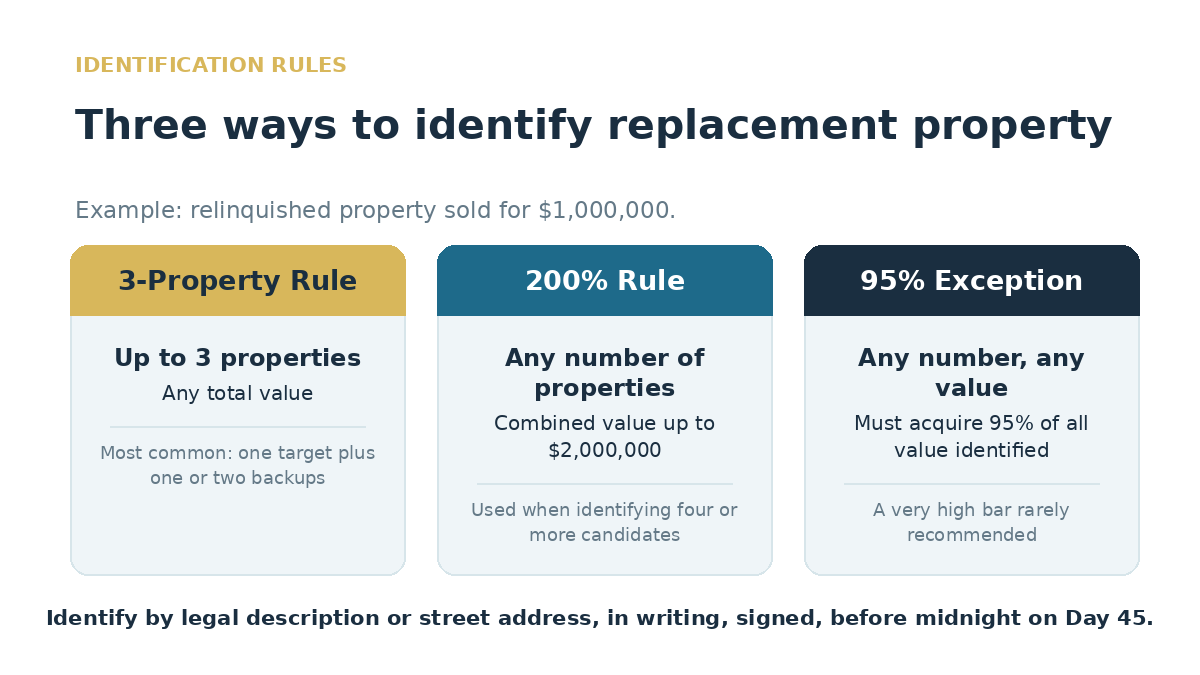
- The Three-Property Rule: Under this most commonly used rule, an investor may identify up to three total properties as potential replacement targets, regardless of their aggregate fair market value. The investor can acquire one, two, or all three of the identified properties. This rule is ideal for investors buying a single primary replacement asset with one or two back-up properties in case negotiations fall through.
- The 200-Percent Rule: If an investor wishes to identify four or more properties, they must use the 200-Percent Rule. Under this rule, the investor can identify any number of properties, provided the total combined fair market value of all identified properties does not exceed 200 percent of the total fair market value of the relinquished property at the time of sale. For example, if the relinquished property sold for $1,000,000, the investor can identify five properties as long as their total combined value does not exceed $2,000,000.
(Note: A third rule, the 95-Percent Exception, allows identifying any number of properties with total value exceeding 200 percent, but requires acquiring at least 95 percent of the total value of all identified properties—a extremely high bar rarely recommended by advisors).
Common Mistakes That Cost Clients Deals
The most catastrophic error an agent can make is allowing a client to submit an ambiguous or non-compliant identification form. Identification notices must contain specific unambiguous descriptions, such as the full legal address, parcel number, or condominium unit number. Simply listing "apartment building on Main Street" is invalid. Furthermore, if a client identifies four properties with a total value exceeding 200 percent of the relinquished property without meeting the 95-percent acquisition threshold, the IRS treats the entire identification notice as if zero properties were identified, invalidating the exchange completely.
Surprising Property Types That Qualify as 1031 Replacements
Many investors remain trapped in low-yield or management-intensive residential rentals simply because they are unaware of the vast array of property types available for like-kind replacement. Realtors who educate clients on diverse real estate categories add immense strategic value.
Multi-Family and Commercial Properties
Moving from single-family residential rentals into multi-family complexes (duplexes, triplexes, 4-units, or commercial 5+ unit apartment buildings) is a classic 1031 strategy. Multi-family assets offer economies of scale, centralized maintenance, and stronger rental cash flows. Similarly, commercial retail buildings, office spaces, and medical centers allow investors to transition into professional real estate sectors with long-term tenant commitments.
Agricultural Land, Industrial Warehouses, and Beyond
Industrial warehouses, distribution centers, flex space, self-storage facilities, and agricultural land (farmland, ranches, timberland) qualify as like-kind real estate. In fact, raw unimproved land can be exchanged for fully developed commercial properties, or vice versa. Additionally, net-lease (NNN) properties—where corporate tenants pay base rent plus property taxes, insurance, and maintenance—provide passive income streams ideal for retiring landlords seeking to eliminate active management burdens.
Properties Realtors Commonly Overlook
Realtors should also introduce clients to specialized property interests that meet Section 1031 qualifications:
- Delaware Statutory Trusts (DSTs): Fractional beneficial ownership interests in institutional-quality commercial real estate portfolios that qualify as direct like-kind replacement property.
- Oil, Gas, and Mineral Rights: Severed perpetual mineral rights and oil/gas royalties held as real property interests.
- Tenant-in-Common (TIC) Interests: Fractional fee-simple ownership in larger commercial properties alongside up to 35 co-owners.
- Easements and Development Rights: Perpetual conservation easements or air/water rights attached to real estate.
By highlighting these alternative property types, resources like x1031 Exchange help realtors expand their market reach while matching investors with property solutions aligned with their financial goals.
How Realtors Prevent Common 1031 Exchange Failures at the Replacement Stage
Statistically, the replacement property stage is where 1031 exchanges face the highest risk of failure. Real estate agents play a direct defensive role in identifying deal risks early and keeping transactions moving forward smoothly.
Why Exchanges Fail and How to Avoid It
Exchanges typically fail during the replacement property stage due to four recurring issues:
- Unrealistic Pricing or Over-Bidding: Investors panic during the 45-day window and overpay for low-quality assets.
- Financing Failures: Lenders fail to underwrite replacement commercial loans before the 180-day closing deadline expires.
- Physical Due Diligence Surprises: Unexpected structural issues discovered late in the inspection period cause the buyer to terminate the contract after the 45-day identification period has closed.
- Contract Inflexibility: Sellers of replacement properties refuse to cooperate with 1031 exchange assignment terms.
To prevent these failures, realtors must push for thorough pre-contract property evaluations, include 1031 cooperation clauses in every purchase contract, insist on fast 10-day inspection periods, and ensure backup properties are formally identified under the Three-Property Rule before Day 45 expires.
Communication Strategies with Clients and Intermediaries
Proactive communication keeps exchange teams synchronized. Real estate professionals should establish weekly timeline tracking calls involving the buyer, the Qualified Intermediary, the mortgage lender, and the closing attorney or escrow officer. Setting automated calendar alerts for Day 1, Day 30, Day 45, and Day 150 ensures that no critical milestone slips through the cracks. Using standardized deal checklists available through educational platforms like x1031 Exchange ensures that every participant operates with clear transparency and urgency.
Common Questions
Frequently Asked Questions
Under Section 1031 of the Internal Revenue Code, like-kind property refers to any real property held for productive use in a trade, business, or for investment purposes. The Internal Revenue Service interprets like-kind broadly across real estate categories. Investors are not restricted to exchanging within the exact same property type; for example, a single-family residential rental can be exchanged for a multi-family apartment building, commercial retail center, industrial warehouse, self-storage facility, or raw agricultural land. The essential statutory requirement is that both the relinquished and replacement properties must be held for business or investment use rather than personal use, primary residence, or immediate fix-and-flip inventory held primarily for resale.
A 1031 exchange provides an investor with exactly 45 calendar days from the date of closing on the relinquished property to formally identify potential replacement property. The 45-day window begins on the day immediately following title transfer and ends at midnight on the 45th day. This statutory deadline is strictly enforced by the IRS and cannot be extended under any circumstances, including weekends, federal holidays, or market conditions, unless an official disaster relief extension is declared by the federal government. To qualify under IRS regulations, the identification notice must be made in writing, signed by the taxpayer investor, and delivered to the Qualified Intermediary before the deadline expires.
If an investor fails to submit a valid, written replacement property identification notice to their Qualified Intermediary by midnight on the 45th calendar day, the 1031 exchange immediately fails. Consequently, the Qualified Intermediary will return the escrowed transaction proceeds to the investor, and the entire sale is treated as a fully taxable transaction. The client will owe immediate federal capital gains taxes, applicable state income taxes, and depreciation recapture for that tax year. Real estate agents should actively assist clients by sourcing replacement properties weeks prior to closing the relinquished property sale to ensure qualifying replacement targets are identified well before statutory deadlines expire.
Top-producing real estate professionals employ proactive multi-channel property sourcing strategies to secure replacement properties quickly within the tight 45-day window. Primary techniques include conducting targeted off-market outreach to commercial property owners and absentee landlords, leveraging specialized commercial property databases, and configuring custom automated MLS alerts. Experienced agents also cultivate strong referral networks with commercial mortgage lenders, local property managers, and syndicators to locate pre-vetted investment opportunities. Furthermore, proactive realtors begin searching for replacement inventory well before the relinquished property transaction closes, allowing investor clients to enter the 45-day identification period with pre-approved commercial financing and vetted target candidates already in motion.
Exchanges most frequently fail during the replacement property stage due to narrow identification windows, commercial financing delays, unexpected physical inspection findings, or seller contract disputes after the 45-day window has closed. Realtors prevent these exchange failures by conducting thorough preliminary property evaluations before submitting formal identification notices, enforcing expedited inspection periods, and securing strong pre-approval commitments from commercial mortgage lenders. Additionally, agents should always identify back-up properties under the IRS Three-Property Rule. Establishing clear communication protocols with the Qualified Intermediary, title officers, closing attorneys, and client tax advisors ensures potential deal roadblocks are addressed quickly before critical statutory deadlines pass.
The IRS provides two primary mathematical rules for identifying replacement properties on or before Day 45. Under the Three-Property Rule, an investor can identify up to three total properties of any dollar value, making it ideal for buyers acquiring one primary target property alongside one or two back-up options. The 200-Percent Rule permits an investor to identify four or more properties, provided the total combined fair market value of all identified properties does not exceed 200 percent of the relinquished property's sales price. Real estate agents must ensure clients strictly adhere to these limits to prevent invalidating their written replacement property identification notice.
Conclusion
Realtors play a decisive, indispensable role in helping real estate investors locate, evaluate, and secure qualifying replacement property during a 1031 exchange transaction. By mastering IRS like-kind definitions, managing strict 45-day identification timelines, utilizing proactive off-market deal sourcing strategies, and correctly applying the Three-Property and 200-Percent rules, real estate professionals safeguard their clients' wealth while positioning themselves as trusted transaction advisors. Guiding investor clients through complex replacement property acquisitions allows real estate agents to capture dual-side transaction commissions, build lasting client loyalty, expand their professional network, and establish a high-value competitive niche across both commercial and residential investment real estate markets.
Go further with x1031 Exchange
For real estate professionals looking to deepen their expertise in 1031 exchange transactions, x1031.com provides comprehensive educational guides, timeline calculators, transaction forms, and compliance checklists. Visit x1031.com today to access expert resources, connect with qualified intermediary support, and confidently streamline your clients' replacement property searches from pre-listing strategy all the way to final closing.
Start your client's exchange →Disclaimer
This article is provided for educational purposes only and does not constitute legal, tax, or financial advice. 1031 exchanges are governed by complex Internal Revenue Code regulations. Real estate agents and investors should always consult with a Qualified Intermediary, certified public accountant (CPA), or real estate attorney regarding specific transaction structures and tax implications.