INVESTOR MORTGAGE GUIDE
Why Investors Use Bridge Loans When 1031 Timing Is Tight
Your investor client just identified the perfect replacement property to complete a 1031 exchange. The seller demands a 21-day closing, but the buyer on your client's relinquished property just requested a 45-day closing extension due to underwriting delays. The statutory 1031 exchange clock is ticking relentlessly, and without immediate action, your client faces a double catastrophe: losing a prime acquisition and incurring an agonizing capital gains tax bill. When conventional mortgage timelines threaten to derail a tax-deferred exchange, real estate investors turn to a specialized financial tool: the bridge loan. As a real estate professional, understanding how and when investors utilize short-term bridge financing allows you to salvage fragile transactions, protect client equity, and solidify your reputation as an indispensable investment advisor.
IN THIS GUIDE
Short-term financing when exchange timing is tight
Why gaps appear
Delayed relinquished closings, fast-close sellers, and slow conventional underwriting.
How bridge loans work
Rapid acquisition, exchange execution, then payoff with sale proceeds or permanent debt.
Costs and trade-offs
Rate premiums, points, and exit fees weighed against the tax being deferred.
The 1031 Exchange Timing Crisis: Why Bridge Loans Matter
A Section 1031 like-kind exchange is one of the most potent wealth-preservation vehicles in real estate investing, allowing property owners to defer federal capital gains taxes, state taxes, and depreciation recapture when selling investment property and acquiring replacement real estate. However, the IRS imposes rigid, unyielding statutory deadlines that make timing the ultimate hurdle in every exchange transaction.
The 45-day and 180-day rules that create urgency
Under Internal Revenue Code Section 1031, an investor faces two critical timeline constraints that begin on the exact day the relinquished property deed is recorded at closing:
- The 45-Day Identification Window: Within exactly 45 calendar days of selling the relinquished property, the investor must formally identify potential replacement properties in writing to a Qualified Intermediary (QI). No extensions are granted for weekends, legal holidays, or natural disasters unless specifically designated by official IRS disaster relief notices.
- The 180-Day Exchange Period: The investor must complete the purchase of the identified replacement property within 180 calendar days of the sale of the relinquished property, or by the tax return due date for the year of sale, whichever is earlier.
Because both statutory clocks run concurrently rather than consecutively, an investor has only 45 days to scout, analyze, negotiate, and formally identify replacement real estate. If financing falls through or closing dates shift during this narrow window, the entire exchange is exposed to catastrophic tax liabilities.
What happens when financing gaps appear
Financing delays are the single leading cause of failed 1031 exchanges. A financing gap typically arises when:
- Closing Delays on Relinquished Property: The buyer of the investor's relinquished property experiences mortgage approval bottlenecks, delaying the release of exchange equity into the Qualified Intermediary escrow account.
- Sellers Demanding Fast Closings: A seller of a prime replacement property refuses to accept a purchase contract contingent on the buyer's sale of another asset, preferring all-cash or fast-closing buyers.
- Slow Institutional Underwriting: Conventional commercial or residential lenders require 45 to 60 days to underwrite, appraise, and fund a standard loan—consuming virtually the entire 45-day identification period.
When cash equity is trapped in an unclosed sale or conventional loan processing moves too slowly, the investor faces "financing paralysis." Without bridge capital, the investor must either forfeit the replacement property or take constructive receipt of sale proceeds, triggering immediate taxation on accumulated capital gains.
How Bridge Loans Work Inside a 1031 Exchange
To navigate severe timing bottlenecks, experienced real estate investors utilize bridge loans—a short-term financing mechanism engineered specifically to span the gap between an immediate capital need and a future liquidity event.
What a bridge loan is and why it's different from traditional financing
A bridge loan is a short-term, asset-backed loan designed to provide immediate capital, typically with a maturity term ranging from 6 to 24 months. Unlike conventional bank mortgages that rely heavily on borrower debt-to-income (DTI) ratios and multi-week institutional underwriting, bridge loans are underwritten primarily based on the property's value, equity margin, and underlying asset quality.
| Feature | Conventional Financing | 1031 Exchange Bridge Loan |
|---|---|---|
| Primary Approval Basis | Borrower Income, Tax Returns, DTI | Property Value, Equity, Loan-to-Value (LTV) |
| Closing Timeline | 45 to 60+ Days | 7 to 14 Calendar Days |
| Loan Term | 15 to 30 Years (Permanent) | 6 to 24 Months (Short-Term) |
| Prepayment Flexibility | Often Includes Yield Maintenance / Penalties | Minimal or Flexible Prepayment Terms |
| Underwriting Focus | Historic Tax Documentation | Asset Collateral & Exit Strategy |
Bridge financing emphasizes execution speed and transactional flexibility, granting investors cash-equivalent purchasing power in competitive markets.
The bridge loan sequence: identifying, closing, and the permanent loan
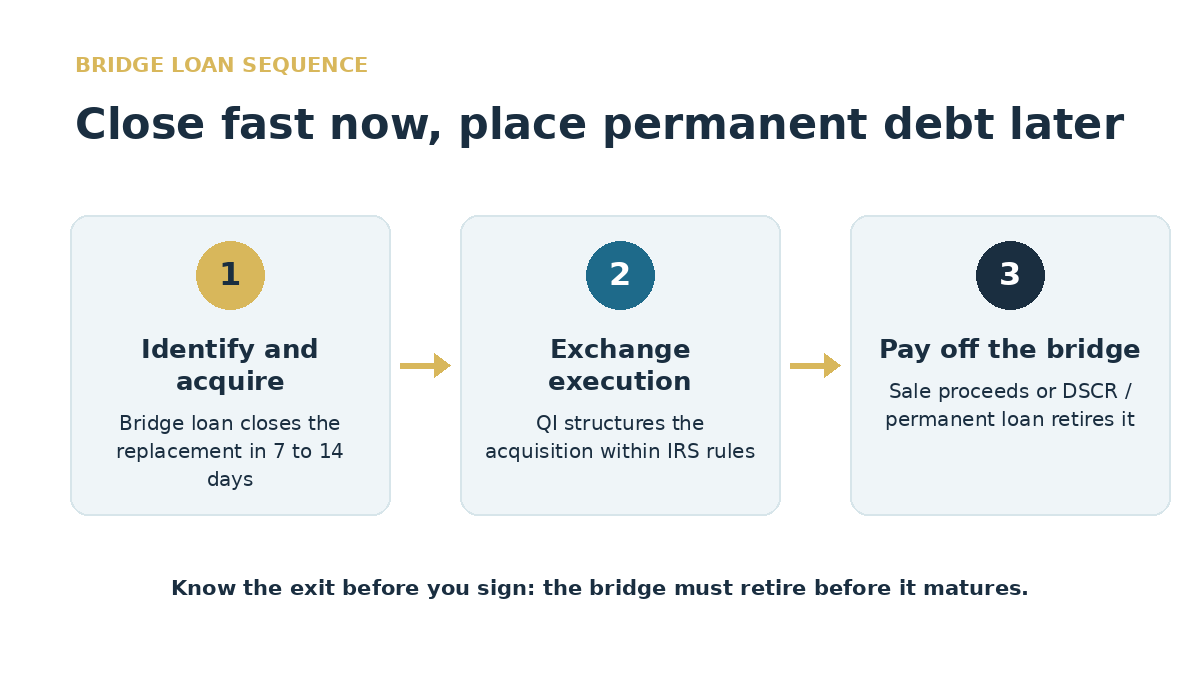
In a 1031 exchange, a bridge loan functions seamlessly within a structured three-step financing sequence:
- Identification & Rapid Acquisition: The investor identifies the replacement property during the 45-day window and secures a bridge loan to close the transaction rapidly, meeting seller demands without waiting for relinquished property sale proceeds.
- Temporary Holding & Exchange Execution: The bridge loan supplies the necessary debt or capital stack component, allowing the Qualified Intermediary to structure the acquisition in compliance with IRS Treasury Regulations.
- Permanent Refinancing or Sale Proceeds Payoff: Once the investor's relinquished property closes—or once long-term institutional financing is underwritten—the bridge loan is paid off in full. The investor replaces short-term debt with permanent conventional, agency, or DSCR financing without disturbing the 1031 tax deferral structure.
Real Reasons Investors Choose Bridge Loans for 1031 Exchanges
Understanding why investors actively opt for higher-cost short-term debt provides realtors with crucial leverage when guiding clients through volatile transactions.
Seizing the right replacement property before competition
High-yield, value-add, or premier commercial properties attract intense buyer competition. Sellers often favor all-cash offers or buyers capable of closing within 10 to 14 days. An investor relying on standard 60-day bank financing will lose prospective deals to cash suitors. A bridge loan empowers an investor to submit non-contingent, fast-closing offers that win competitive bidding wars.
Closing quickly without waiting for buyer financing to close on the relinquished property
In an ideal exchange, the relinquished property closes first, transferring cash directly to the Qualified Intermediary. However, real estate transactions rarely move in perfect synchronization. If a buyer on the relinquished property faces lender delays, a bridge loan—or a bridge-financed reverse 1031 exchange structure—allows the investor to close on the replacement property immediately. The investor does not have to watch a lucrative deal collapse while waiting for a sluggish buyer.
Reducing the risk of missing the 180-day reinvestment deadline
The 180-day timeline offers zero leeway. If a conventional lender denies a loan application on day 120, the investor has only 60 days to secure alternative financing, order an appraisal, and close title. Switching to a bridge lender provides a guaranteed execution path that eliminates deadline anxiety and protects accumulated equity from capital gains exposure.
Why Realtors Should Understand (and Mention) 1031 Exchange Bridge Loans
Realtors who understand short-term financing elevate their practice from basic property listing to high-value strategic advisory. Platforms like x1031 Exchange help realtors understand these debt structures so agents can guide clients effectively during high-stakes deals.
The missed commission and lost client trust scenario
Consider an agent representing an investor selling a $1.5 million apartment building. The seller intends to enter a 1031 exchange to buy a $2.0 million retail center. If the buyer's lender on the relinquished sale delays closing beyond the 45-day identification deadline, the exchange fails. The seller cancels the replacement property purchase, forfeits earnest money, incurs a massive tax bill, and blames the listing agent for failing to anticipate financing risks. The agent loses the buy-side commission and destroys a long-term client relationship.
Positioning yourself as a trusted advisor, not just a transaction facilitator
When you proactively introduce bridge financing solutions before timeline bottlenecks occur, you demonstrate sophisticated market knowledge. You show investors that you understand equity preservation, debt replacement rules, and capital execution strategies. Investors reward knowledgeable realtors with repeat listings, buy-side representation, and lucrative network referrals.
The compliance gray zone: When is it tax advice versus market education?
Real estate licensees must maintain a strict compliance boundary between market education and formal legal or tax counsel.
- Market Education (Permissible): "Investors facing tight 1031 exchange timelines frequently explore bridge loans or short-term debt options to secure replacement properties before conventional loans fund."
- Tax/Legal Counsel (Impermissible): "You should take out a bridge loan on this specific property because it will guarantee you avoid capital gains taxes under Section 1031."
Always encourage clients to consult their CPA, tax attorney, and Qualified Intermediary while offering educational concepts and market resources.
Bridge Loan Costs and Trade-offs Investors Should Know
While bridge loans solve severe timing problems, they represent short-term capital and carry distinct cost structures that investors must evaluate carefully.
Interest rates and fees compared to traditional financing
Because bridge lenders absorb higher short-term risk and provide rapid execution, their pricing reflects a premium over conventional mortgage products:
- Interest Rates: Typically range from 2.0% to 4.0% above prevailing conventional mortgage benchmark rates. Most bridge loans carry interest-only payment structures to minimize monthly cash outlay.
- Origination Fees (Points): Lenders generally charge 1.0 to 2.0 origination points at closing, alongside administrative, valuation, and legal processing fees.
- Exit Fees: Certain bridge facilities assess a 0.5% to 1.0% exit fee upon payoff, though many lenders waive exit penalties if the borrower transitions into the lender's permanent loan program.
The short-term cost vs. long-term tax benefit calculation
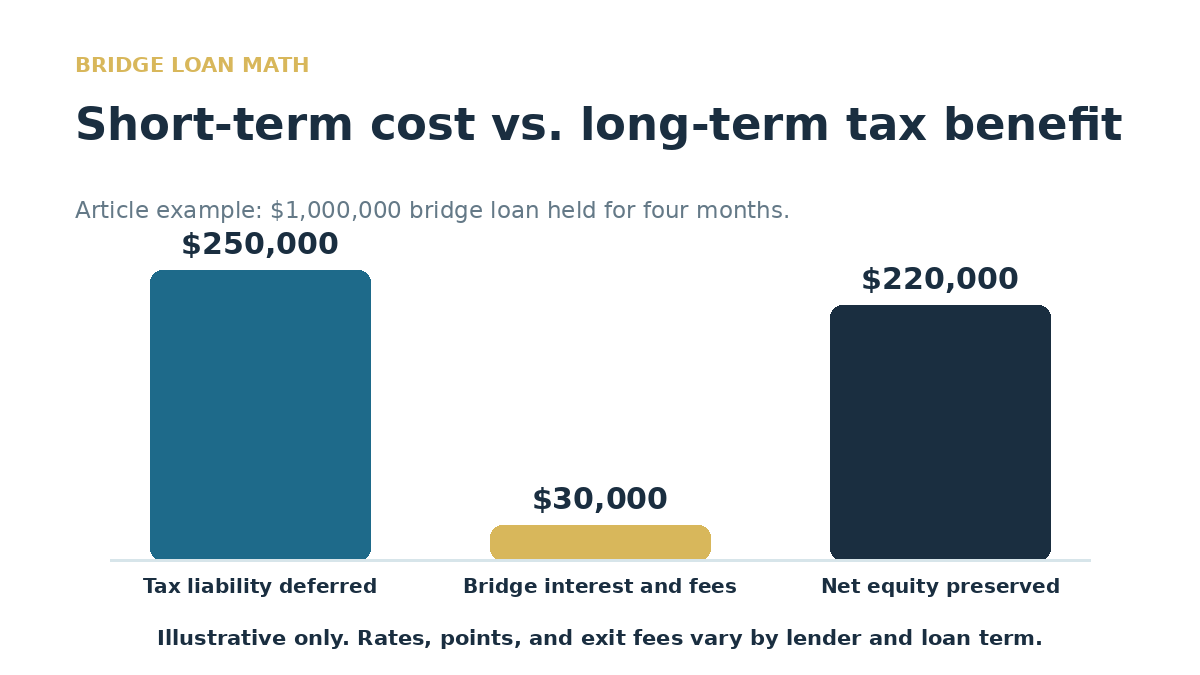
Investors evaluate bridge financing by weighing total short-term borrowing expenses against immediate capital gains tax liability.
For example, assume an investor faces a $250,000 tax liability on a relinquished property sale. Securing a $1,000,000 bridge loan for four months might cost $30,000 in interest and origination fees. Spending $30,000 in short-term financing costs to defer a $250,000 tax bill yields a net financial preservation of $220,000. For serious property investors, paying short-term bridge fees is a rational and highly profitable trade-off to protect long-term equity.
Common Realtor Mistakes When Advising on 1031 Exchange Timelines
Even experienced real estate agents make costly assumptions when handling 1031 exchange transactions. Avoiding these common pitfalls protects both your clients and your professional license.
Assuming the buyer's lender will close in time
Never assume a buyer's conventional mortgage approval will proceed without delays. Title issues, appraisal shortfalls, employment re-verifications, and underwriting documentation requests frequently delay closings by two to three weeks. Always build contingency plans and monitor the buyer's loan progress weekly.
Not proactively raising the bridge loan conversation
Many realtors wait until day 40 of the 45-day identification period to address financing hurdles. By that point, options are severely constrained. Proactively discussing bridge financing options during pre-listing strategy sessions ensures your client has pre-vetted short-term lending relationships ready for immediate deployment.
Confusing 1031 exchanges with other investment strategies
A 1031 exchange is strictly governed by Treasury Regulations. It cannot be conflated with standard primary residence exclusions (Section 121), installment sales (Section 453), or Opportunity Zone investments. Each strategy carries unique holding period requirements, qualification rules, and debt replacement mechanics that demand specialized knowledge.
Common Questions
Frequently Asked Questions
A 1031 exchange is an Internal Revenue Code provision allowing real estate investors to defer federal capital gains taxes, state taxes, and depreciation recapture when selling an investment property and reinvesting proceeds into a like-kind replacement asset. Realtors must thoroughly understand 1031 exchanges because investment property sales represent high-value transactions that frequently generate dual commissions across both relinquished sales and replacement acquisitions. By understanding statutory timelines, debt replacement rules, and financing options, realtors can guide investor clients through complex deal structures, prevent costly transaction failures, and position themselves as trusted wealth-building advisors in competitive commercial and residential investment real estate markets across all local property jurisdictions.
In a 1031 exchange, a bridge loan provides short-term asset-backed financing to acquire a replacement property rapidly when conventional mortgage approval moves too slowly or when relinquished property sale proceeds are delayed. Underwritten primarily on property equity and collateral value rather than borrower income, bridge loans can close in seven to fourteen calendar days. The Qualified Intermediary integrates the bridge loan debt into the exchange structure, allowing the investor to meet strict IRS identification and acquisition deadlines. Once the relinquished property closes or long-term financing is secured, the investor refinances or pays off the bridge loan, preserving full tax deferral and ongoing cash flow stability.
If an investor fails to formally identify replacement property in writing to their Qualified Intermediary within the strict 45-calendar-day window, the entire 1031 exchange invalidates automatically. The IRS grants no administrative grace periods or extensions for lender delays. Consequently, the sale of the relinquished property becomes a fully taxable transaction, triggering immediate federal capital gains taxes, state taxes, and depreciation recapture liabilities. To prevent this severe financial outcome, realtors should encourage investor clients to pre-qualify with reliable bridge lenders or Qualified Intermediaries well before listing relinquished properties, ensuring fast-closing capital is available if conventional financing stalls or escrow timelines shift.
While realtors are not licensed to provide formal legal or tax counsel, they have a professional obligation to inform clients about relevant market solutions and transaction strategies. Proactively introducing 1031 exchange concepts and bridge loan financing options helps sellers evaluate potential tax deferral strategies before executing purchase contracts. Realtors should introduce these concepts educationally, recommending that clients consult CPAs, attorneys, and Qualified Intermediaries. Proactively raising short-term financing options protects clients from unexpected timing bottlenecks, preserves investor equity, and demonstrates a high standard of care and market expertise that distinguishes top-tier investment real estate professionals from basic transaction facilitators.
Bridge loan interest rates are typically two to four percentage points higher than conventional permanent mortgage rates, reflecting the short-term nature, rapid underwriting speed, and asset-focused risk profile of short-term lending. Additionally, bridge lenders usually assess one to two origination points plus standard third-party processing fees. However, bridge loans are structured primarily with interest-only monthly payments to minimize holding costs during the transition period. Investors evaluate these short-term borrowing costs against their immediate tax liability; paying short-term premium interest to successfully execute a 1031 exchange and defer tens or hundreds of thousands in capital gains taxes remains highly cost-effective and profitable.
1031 exchanges most frequently fail due to financing gaps when conventional mortgage underwriters take longer than 45 days to process replacement property loan applications. Other common causes include unexpected loan denials late in the escrow period, closing delays on the relinquished property that trap required equity, and rigid sellers who refuse purchase contracts with loan contingencies. Furthermore, failing to replace existing mortgage debt on the relinquished property can create taxable mortgage boot. Real estate investors mitigate these financing risks by utilizing fast-closing bridge loans, pre-qualifying with specialized lenders, and coordinating closely with experienced Qualified Intermediaries to maintain continuous IRS regulatory compliance.
Realtors should direct investor clients to specialized 1031 exchange educational platforms, experienced Qualified Intermediaries, and established private money or commercial bridge lenders. Educational resources like x1031 Exchange provide realtors and investors with comprehensive guides, timeline tools, and expert coordination resources to evaluate short-term debt and exchange mechanics safely. Connecting clients with knowledgeable 1031 specialists early in the transaction process ensures all bridge loan structures, assignment agreements, and escrow instructions comply fully with IRS Treasury Regulations. Visit x1031 Exchange to explore professional educational resources, timeline calculators, and specialized 1031 exchange None coordination tools for your upcoming investment deals, market analysis, and client consultations.
Conclusion
Navigating 1031 exchange deadlines requires absolute precision, proactive strategy, and versatile financing solutions. When statutory 45-day and 180-day windows create timing crises, bridge loans provide real estate investors with the speed and flexibility needed to secure prime replacement properties and preserve substantial equity. By understanding how bridge financing integrates into exchange workflows, real estate agents can spot financing gaps early, save fragile deals from collapse, and position themselves as elite investment advisors. Mastering these short-term capital strategies elevates your real estate practice, protects client wealth, and ensures long-term professional success in competitive commercial and residential investment markets.
Next Steps & Resources
To deepen your expertise in 1031 exchange rules, short-term financing strategies, and transaction workflows, visit x1031.com. Access comprehensive realtor guides, downloadable client checklists, and expert coordination tools to guide your investor clients through seamless, tax-deferred exchanges. Head to x1031 Exchange today to elevate your real estate practice and master investment property transactions.
Start Your Exchange →Disclaimer
Educational information only. x1031 Exchange does not provide legal, tax, or mortgage advice. Real estate investors and agents should consult their Qualified Intermediary, attorney, CPA, and licensed mortgage professional regarding specific transaction structures and regulatory compliance.