INVESTOR MORTGAGE GUIDE
5 Reverse 1031 Exchange Financing Mistakes Investors Make That Kill Their Tax Deferral
You've identified the perfect replacement property, your 1031 exchange timeline is locked, but your lender just pulled the financing because the exchange accommodation titleholder structure doesn't fit their standard underwriting box. Now you're 45 days into your 180-day exchange window with no clear path forward.
Executing a reverse 1031 exchange under IRS Revenue Procedure 2000-37 allows investors to acquire a replacement property before selling their relinquished property. However, acquiring the replacement property first flips the traditional financing dynamic on its head. Mainstream institutional mortgage underwriters operate inside rigid secondary market boxes designed for conventional fee-simple purchases. When confronted with an Exchange Accommodation Titleholder (EAT) taking legal title to park the property, standard loan origination systems stall.
Failing to align your financing strategy with reverse exchange mechanics does not just cause closing delays—it risks triggering constructive receipt of funds or failing the strict 180-day exchange window, resulting in immediate capital gains tax recognition, depreciation recapture taxation, and state tax liabilities.
IN THIS GUIDE
Financing the replacement before the sale
The EAT problem
Why an accommodation titleholder on title stalls conventional underwriting.
Five costly mistakes
Late financing, the wrong lender, overleverage, EAT document review, and bridge exits.
What works
Portfolio, bank statement, Non-QM DSCR, and private structures, plus the hidden costs.
How Reverse 1031 Exchange Financing Actually Works (And Where Investors Get It Wrong)
Understanding reverse 1031 exchange financing requires mastering the structural role of the Exchange Accommodation Titleholder (EAT). In a standard forward exchange, the investor sells the relinquished property first, and the Qualified Intermediary (QI) holds the proceeds until the replacement property is purchased. In a reverse exchange, the investor must acquire the replacement property before the sale of the relinquished property closes.
Because an investor cannot legally own both the relinquished property and the replacement property simultaneously while claiming a tax-deferred exchange, IRS Revenue Procedure 2000-37 created a safe harbor mechanism. Under this safe harbor, an independent entity known as an EAT takes legal title to park either the replacement property (parking the replacement property) or the relinquished property (parking the relinquished property) for up to 180 calendar days.
The Exchange Accommodation Titleholder (EAT) Problem
The primary financing roadblock in a reverse exchange is the EAT's presence on title. When parking a replacement property, the EAT becomes the technical legal owner and titleholder of record until the investor sells the relinquished property and completes the exchange. Most conventional residential mortgage lenders and agency underwriters (Fannie Mae, Freddie Mac, FHA) require the borrower on the promissory note to match the titleholder on the deed exactly. When a conventional lender discovers that an LLC managed by a Qualified Intermediary—the EAT—will hold title rather than the individual investor or their personal single-member LLC, standard underwriting guidelines reject the application. Lenders fear title encumbrance, loss of recourse, or lien priority complications, creating the "EAT Problem" that stalls unsuspecting investors at the closing table.
The 45-Day Identification Window Doesn't Stop the Clock
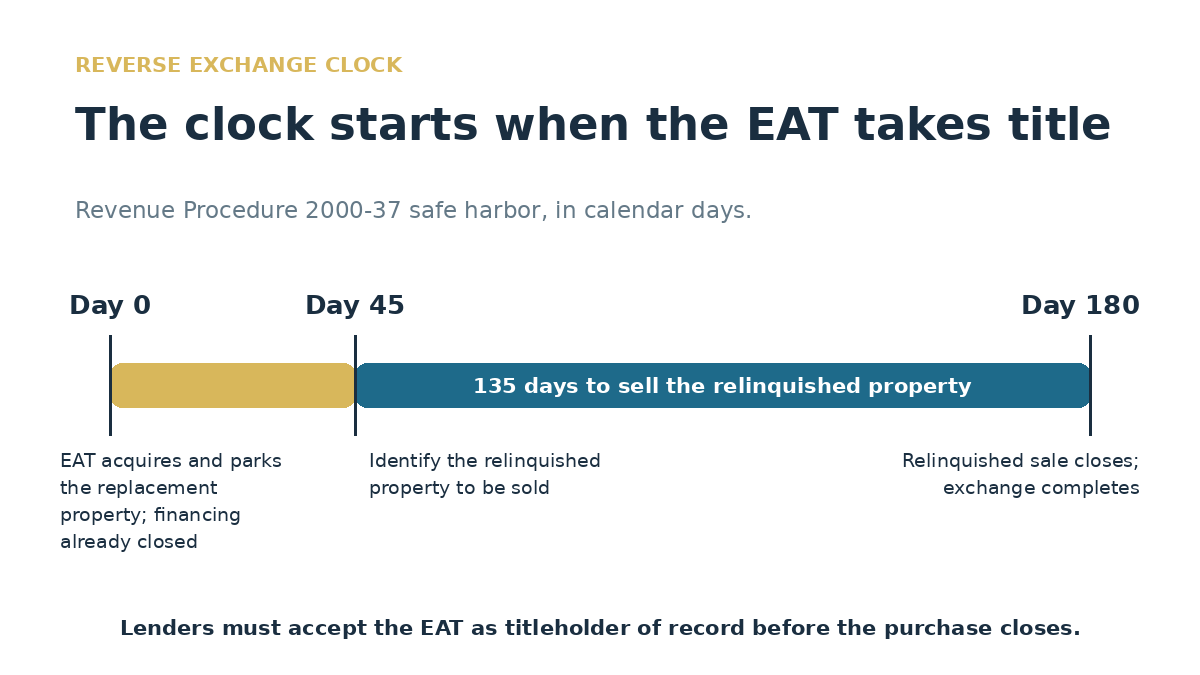
Investors frequently confuse the identification rules of a reverse exchange with those of a forward exchange. In a reverse 1031 exchange, the statutory clock starts the moment the EAT acquires legal title to the parked property.
Within 45 calendar days of the EAT taking title, the investor must formally identify in writing which relinquished property (or properties) will be sold to complete the exchange. Unlike forward exchanges where investors have 45 days after a sale to find a replacement property, reverse exchange investors must already have their purchase financing closed and operational when the 45-day identification clock begins. Relying on slow loan approvals during this window creates severe timing pressure, as any delay in selling the relinquished property within the remaining 135 days destroys the safe harbor status.
The 5 Financing Mistakes That Destroy Tax Deferral Status
Navigating reverse 1031 exchange financing requires anticipating where institutional lenders and tax rules conflict. Avoiding these five critical mistakes preserves tax deferral status and prevents deal failure.
Mistake #1: Waiting Too Long to Secure Financing (The Timeline Trap)
The most catastrophic mistake investors make is applying for financing after opening the reverse exchange or executing the purchase contract. Traditional commercial mortgage underwriting takes 45 to 60 days. If an investor signs a purchase agreement without pre-approved financing tailored to an EAT structure, loan delays will consume precious days of the 180-day safe harbor window.
If financing falls through late in the process, the investor risks forfeiting earnest money deposits or taking direct title to the replacement property without an EAT. Taking direct title destroys the reverse exchange structure instantly, transforming a tax-deferred acquisition into a fully taxable transaction.
Mistake #2: Choosing the Wrong Lender (Not All Lenders Understand Reverse Exchanges)
Many investors mistakenly assume their long-standing commercial bank or preferred mortgage broker can handle a reverse 1031 exchange loan. However, standard retail lenders rarely have experience with Qualified Exchange Accommodation Agreements (QEAA) or EAT title structures.
When an inexperienced lender attempts to adapt a conventional loan to an EAT transaction during underwriting, their legal department often demands unacceptable personal guarantees, title indemnifications, or deed transfers that violate IRS safe harbor rules. Working with specialized portfolio lenders who routinely finance EAT-held properties ensures underwriting guidelines align with tax requirements from day one.
Mistake #3: Overleveraging Based on Unrealistic Debt-to-Income Calculations
In a reverse exchange, the investor must service the debt on the newly acquired replacement property while simultaneously carrying the mortgage, taxes, insurance, and maintenance costs on the unsold relinquished property.
Underwriters evaluate the investor's global cash flow and debt service coverage ratio (DSCR). Investors who overleverage or assume the relinquished property will sell immediately often fail global cash flow stress tests. If debt service requirements exceed debt-to-income (DTI) thresholds before the relinquished property sells, lenders will deny loan approval, leaving the investor unable to complete the acquisition.
Mistake #4: Ignoring the Exchange Accommodation Titleholder's Role in Underwriting
The EAT is an independent contractual entity, not a personal co-borrower. Investors often fail to inform their lender that the EAT must review and approve all loan documentation, mortgages, deeds of trust, and personal guaranty agreements prior to closing.
Because the EAT holds legal title to the collateral property, the lender's mortgage or deed of trust must name the EAT as the mortgagor while naming the investor (or investor's entity) as the borrower on the promissory note. If the lender's legal counsel drafts loan documents that treat the EAT as a non-recourse guarantor without proper indemnity protections, the EAT will refuse to sign, halting the closing hours before funds are disbursed.
Mistake #5: Using Bridge Loans Without Understanding the Exit Strategy
Bridge loans offer rapid execution for reverse exchanges, but using short-term debt without a clear, stress-tested exit strategy is extremely dangerous. A bridge loan provides temporary liquidity to acquire the replacement property, intended to be paid off when the relinquished property sells and proceeds are transferred through the QI.
If local market conditions slow the sale of the relinquished property beyond the 180-day safe harbor limit, or if the sale price drops below expectations, the investor faces a dual crisis: a maturing high-interest bridge loan and a fully taxable failed exchange.
What Loan Types Actually Work for Reverse 1031 Exchanges
To successfully finance a reverse exchange, investors must utilize debt structures specifically compatible with EAT title ownership and non-standard closing mechanics.
Traditional Portfolio Loans
Portfolio loans are originated and retained on a bank's own balance sheet rather than being sold into the secondary mortgage market (Fannie Mae/Freddie Mac). Because portfolio lenders establish their own underwriting guidelines, regional commercial banks and private wealth institutions can customize loan terms to accommodate an EAT on title. Portfolio loans offer competitive interest rates and long-term amortizations, making them an ideal permanent financing vehicle if arranged early.
Bank Statement and Asset-Based Lending Programs
For self-employed real estate investors or active portfolio managers, bank statement and asset-based loans evaluate qualification based on 12 to 24 months of cash flow or personal liquidity rather than tax return net income. These non-qualified mortgage (Non-QM) products frequently feature flexible entity vesting guidelines that allow an EAT to hold title while the investor guarantees the note based on cash flow strength.
Non-Traditional Financing and Private Lending Structures
When institutional timing is too restrictive, private capital and non-traditional lenders provide rapid asset-backed funding. Private lenders focus primarily on loan-to-value (LTV) ratios and the underlying equity in both the replacement and relinquished properties. While interest rates are higher than conventional bank debt, private lending structures can close within 10 to 14 business days, ensuring the replacement property is secured before the purchase contract expires.
Why Bridge Loans Are Overused (And What Might Work Better)
While bridge loans are widely touted for reverse exchanges due to their speed, they carry high origination points, exit fees, and short maturity windows. In many cases, a combination of a fixed DSCR loan on the replacement property paired with a short-term equity line of credit (HELOC) or business line on the investor's existing assets provides lower capital costs, greater execution certainty, and reduced timing stress.
The Hidden Costs Nobody Warns Investors About
Executing a reverse 1031 exchange involves operational costs significantly higher than standard forward exchanges. Unanticipated expenses can quickly erode expected tax savings if not budgeted in advance.
Extended Holding Period Costs
Because the investor carries two properties concurrently during the reverse exchange window, holding costs double. Investors must budget for concurrent mortgage payments, property management fees, real estate taxes, utilities, and landlord insurance policies on both assets until the relinquished property sale closes.
Loan Modification and Release Fees
When the relinquished property eventually sells and exchange funds are transferred through the QI to pay down debt on the replacement property, lenders may charge loan modification, principal curtailment, or partial release fees. Investors must review loan documents upfront to ensure lenders permit lump-sum principal paydowns without imposing pre-payment penalties.
Insurance and Title Complications
Insuring a property held by an EAT requires specialized endorsement policies. Commercial insurance carriers must issue hazard and liability coverage naming both the EAT and the investor as additional insureds. Additionally, title insurance companies charge specialized EAT endorsement fees and double-recording fees when title transfers from the seller to the EAT, and subsequently from the EAT to the investor upon exchange completion.
Compliance Documentation and Legal Fees
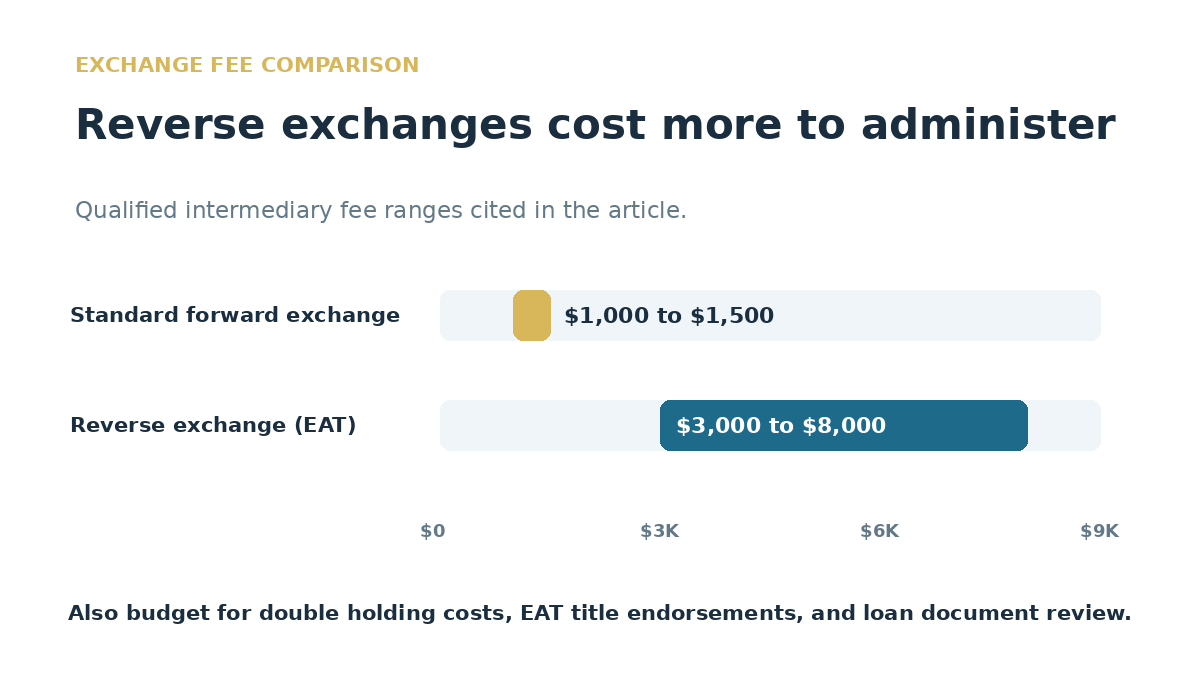
Qualified Intermediary fees for a reverse exchange typically range from $3,000 to $8,000—substantially higher than the $1,000 to $1,500 charged for standard forward exchanges. Furthermore, attorney fees for drafting the QEAA, reviewing lender loan agreements, and structuring EAT organizational documents add necessary compliance overhead.
Real-World Scenarios: How Successful Investors Navigate Reverse Exchange Financing
Analyzing how experienced investors structure financing provides a blueprint for executing complex reverse exchanges safely.
The Multi-Property Portfolio Strategy
An investor holding three stabilized residential rental properties identified a commercial strip center priced at $2.5 million. Recognizing that selling three residential units concurrently within a tight window was unrealistic, the investor utilized a portfolio umbrella loan secured by the equity in their existing properties. The lender advanced $2.5 million directly to the EAT to acquire the strip center. Over the subsequent 120 days, the investor sold two residential properties, transferring $1.8 million in net proceeds through the QI to pay down the portfolio loan, successfully deferring $450,000 in capital gains taxes.
The Equity Maximization Approach
An investor owning a high-equity, unencumbered apartment building needed to secure a $1.2 million replacement property immediately. Rather than taking out a high-cost bridge loan on the replacement property, the investor executed a pre-exchange refinance on another unencumbered asset in their portfolio to generate $1.2 million in cash liquidity. The investor then advanced these personal funds as a member loan to the EAT, allowing the EAT to purchase the replacement property for cash without third-party lender underwriting delays.
The Creative Financing Hybrid Model
A commercial investor used a hybrid model combining a Non-QM DSCR loan and seller financing. The investor secured a 65% LTV DSCR loan on the replacement property where the lender agreed to name the EAT as titleholder. To cover the remaining 35% equity gap, the seller accepted a short-term second mortgage note that was paid off in full 90 days later when the investor's relinquished property closed.
How to Position Yourself for Reverse 1031 Exchange Financing Success
Flawless execution of a reverse 1031 exchange requires proactive planning, rigorous documentation, and seamless coordination across your professional advisory team.
Start the Financing Conversation Before You Identify a Replacement Property
Never wait until a replacement property is under contract to seek financing. Engage specialized lenders and mortgage advisors before making offers. Establishing pre-approved credit lines or identifying portfolio lenders who understand EAT structures ensures you can submit competitive, non-contingent purchase offers with complete closing confidence.
Gather Documentation Early (Bank Statements, Tax Returns, Asset Statements)
Underwriting reverse exchange financing requires comprehensive asset documentation. Gather 24 months of personal and business tax returns, profit-and-loss statements for all real estate holdings, liquidity verification, and entity formation documents well before entering negotiations.
Work With Lenders and Exchange Accommodation Titleholders Who Communicate
Clear communication between your lender and the EAT is critical. Ensure your lender's legal department speaks directly with the EAT's closing coordinator before loan documents are finalized to verify vesting language, mortgage clauses, and signature blocks. Working with experienced advisors like x1031 Exchange specialization partners eliminates costly legal miscommunications and streamlines underwriting workflows.
Build Your Team (Accountant, Tax Attorney, Qualified Intermediary, Lender)
A reverse 1031 exchange is a synchronized financial operation. Assemble an experienced team comprising a CPA specializing in real estate taxation, an attorney knowledgeable in IRS Revenue Procedure 2000-37, a reputable Qualified Intermediary, and a specialized mortgage advisor. Aligning your professional team early ensures full compliance, protects tax deferral status, and maximizes long-term portfolio growth.
Common Questions
Frequently Asked Questions
A reverse 1031 exchange allows an investor to acquire a replacement investment property before selling their relinquished property, preserving tax deferral under IRS Revenue Procedure 2000-37 safe harbor rules. Financing a reverse exchange requires an Exchange Accommodation Titleholder (EAT) to take legal title to the parked property to prevent the investor from owning both assets simultaneously. Financing works by securing specialized portfolio, private, or asset-based loans where the lender agrees to fund the purchase while naming the EAT as the legal titleholder on the deed of trust. The investor acts as the note borrower or guarantor, and loan proceeds or equity are later rebalanced when the relinquished property sells within the 180-day window.
An Exchange Accommodation Titleholder (EAT) significantly impacts loan underwriting because conventional mortgage lenders require the borrower named on the promissory note to match the titleholder on the deed. Because the EAT holds legal title to satisfy IRS safe harbor rules, conventional Fannie Mae and Freddie Mac underwriters will reject the application. Obtaining a loan requires working with specialized portfolio lenders, commercial banks, or Non-QM lenders who permit non-borrower titleholders. The lender must draft security documents naming the EAT as the mortgagor while accepting a personal guaranty or promissory note from the investor, requiring custom loan documentation and pre-closing legal coordination between all transaction parties.
Getting a mortgage during a reverse 1031 exchange is notoriously difficult because institutional mortgage platforms are rigidly built for conventional fee-simple purchases. Standard automated underwriting software cannot process non-standard transactions where an independent third-party entity like an Exchange Accommodation Titleholder holds legal title. Additionally, underwriters evaluate the investor's global debt service coverage, requiring them to qualify for mortgages, property taxes, and hazard insurance on both the newly acquired replacement property and the unsold relinquished property simultaneously. This dual debt burden creates strict debt-to-income and cash flow hurdles that conventional residential lenders are unwilling or unable to navigate without customized manual portfolio underwriting and specialized loan structuring guidance.
The best loan types for a reverse 1031 exchange are portfolio commercial loans, Non-QM DSCR loans, bank statement loans, and private bridge financing. Portfolio loans from regional banks work well because the lender retains the loan on its balance sheet, allowing custom underwriting that accommodates an Exchange Accommodation Titleholder on title. Debt Service Coverage Ratio (DSCR) and bank statement loans focus on property rental income or cash flow rather than personal tax returns, easing qualification. Short-term bridge loans or private equity lines also provide rapid capital to close quickly, provided the investor has a firm exit strategy when the relinquished property sells.
To qualify for reverse 1031 exchange financing, lenders typically require substantial equity in the relinquished property—often 30% to 50% or more—if that equity is being leveraged to secure financing. When cross-collateralizing or securing a cash-out refinance on existing assets to fund the EAT purchase, lenders look for maximum combined loan-to-value (CLTV) ratios of 65% to 75%. Furthermore, to achieve full tax deferral under Section 1031 rules, the net purchase price and debt on the replacement property must equal or exceed the net sale price and debt of the relinquished property, making sufficient equity essential for both qualification and tax protection.
A bridge loan is not the only option for a reverse 1031 exchange, and superior alternatives often exist depending on the investor's balance sheet strength. While bridge loans offer rapid execution, they carry higher interest rates, origination points, and short maturity deadlines. Excellent alternatives include long-term portfolio loans from regional commercial banks, Non-QM DSCR loans, or drawing on an established business line of credit or HELOC from other unencumbered real estate assets. Advancing personal cash or private partner capital to the Exchange Accommodation Titleholder as a structured member loan often provides lower capital costs and eliminates institutional underwriting delays completely.
Hidden costs in reverse 1031 exchange financing include elevated Exchange Accommodation Titleholder (EAT) setup and administration fees ($3,000 to $8,000+), specialized legal document review fees, double title recording taxes, and custom insurance endorsement premiums. Because the property is parked with an EAT, title companies charge transfer taxes upon initial acquisition and secondary conveyance to the investor upon exchange completion. Additionally, investors face double holding costs—paying concurrent mortgages, property taxes, insurance, and utilities on both properties during the 180-day window. Finally, lenders may charge loan modification or principal curtailment fees when exchange proceeds pay down replacement property debt after the sale.
Conclusion
Navigating reverse 1031 exchange financing requires a deliberate, disciplined strategy that bridges complex tax regulations with specialized commercial lending practices. While the reverse exchange structure empowers real estate investors to secure premier replacement properties in competitive markets without waiting for a sale, mismanaging the financing aspect presents severe risks to tax deferral status. From underwriting roadblocks caused by Exchange Accommodation Titleholders to unexpected holding costs, double recording fees, and dual-debt liabilities, avoiding critical financing errors is essential to preserving long-term wealth. Success depends on proactive planning, establishing relationship-based portfolio or Non-QM financing early, and working with specialized lending partners who understand IRS Revenue Procedure 2000-37 mechanics thoroughly. By assembling a synchronized advisory team—including a knowledgeable Qualified Intermediary, tax CPA, real estate attorney, and specialized mortgage broker—investors can navigate reverse exchange financing seamlessly, meet every statutory deadline, protect capital gains, avoid constructive receipt traps, and achieve full tax deferral across their investment property acquisitions.
Get Expert 1031 Financing Guidance
If you are preparing for a reverse 1031 exchange and need financing that aligns perfectly with your timeline and exchange structure, connect with the specialists at x1031.com today. Our experienced team matches real estate investors with specialized lenders and Qualified Intermediaries who understand reverse exchanges inside and out. Whether you need portfolio financing, Non-QM DSCR underwriting, or asset-backed capital, we ensure your loans close on schedule, eliminate underwriting friction, protect your tax deferral status, and support your long-term real estate portfolio growth strategies.
Plan a reverse exchange →Disclaimer
Educational information only. x1031 Exchange is not a law firm, CPA firm, or Qualified Intermediary, and does not provide legal, tax, or formal tax deferral advice. Always consult your CPA, tax attorney, and Qualified Intermediary regarding your specific transaction.
Sources and official references