INVESTOR MORTGAGE GUIDE
Does Rental Income From the Replacement Property Count Toward DSCR Qualification Before Closing? Here's What Lenders Really Do
Forty-two days into a strict 45-day identification period, an investor identifies a fully occupied fourplex as their target 1031 replacement property. The seller provided leases showing $8,000 in monthly gross rent, easily exceeding the required $6,200 monthly debt service needed to achieve a 1.25 Debt Service Coverage Ratio (DSCR). However, when submitting the loan application, the underwriter flags the file: because the investor does not currently own the property, the lender refuses to count the uncollected pre-closing rental income toward the investor's baseline DSCR qualification.
This situation reveals one of the most frequent points of confusion for real estate investors using DSCR loans in a 1031 exchange. While DSCR financing evaluates property-level cash flow rather than personal tax returns or W-2 income, lenders enforce strict rules regarding when and how replacement property rental income can be recognized during underwriting.
IN THIS GUIDE
How lenders count rent on a property you don't own yet
The short answer
Seller-collected rent isn't your income; lenders verify the property's earning capacity.
How income is set
Leases, Form 1007 rent schedules, T-12 statements, and the lower-of rule.
Three scenarios
An occupied duplex, a vacant single-family rental, and a rolled-over tenant.
1. The Short Answer: Does Pre-Closing Rental Income Count Toward DSCR Qualification?
The direct answer is generally no: rental income collected by the current owner prior to closing cannot be credited as the borrower's personal historical income during DSCR underwriting. Lenders do not grant a buyer credit for cash flow generated while the property was under previous ownership.
Instead, DSCR underwriters evaluate the property's demonstrated or projected earning capacity to determine whether the asset will generate sufficient income after ownership transfers. Understanding this distinction is vital for investors navigating the strict timelines of a 1031 exchange.
Why the Timing Matters in Your 180-Day Window
In a 1031 exchange, Section 1031 of the Internal Revenue Code mandates that investors must close on their identified replacement property within 180 calendar days of selling their relinquished property. Because funds are held securely by a Qualified Intermediary (QI), any financing delay threatens the tax-deferred status of the entire transaction.
If an underwriter rejects projected rents or demands additional lease verifications late in the 180-day window, the investor risks missing the closing deadline. Discovering how a lender treats pre-closing rental income on day 40 of identification prevents last-minute financing collapses.
What "Qualification" Actually Means for DSCR Lenders
For a conventional mortgage, qualification centers on the borrower's debt-to-income (DTI) ratio, personal tax returns, and employment history. In contrast, DSCR loan qualification centers on a single mathematical formula:
DSCR = Gross Monthly Rental Income (or Net Operating Income) ÷ Monthly Debt Service (Principal, Interest, Taxes, Insurance, HOA)
A DSCR ratio of 1.00 means the property's gross income exactly covers its debt obligations. Most institutional DSCR lenders require a minimum ratio between 1.15 and 1.25. When underwriters calculate this ratio before closing, they must establish the "Gross Monthly Rental Income" figure using lender-approved documentation rather than seller assertions.
2. How DSCR Loans Calculate Income for Investment Properties
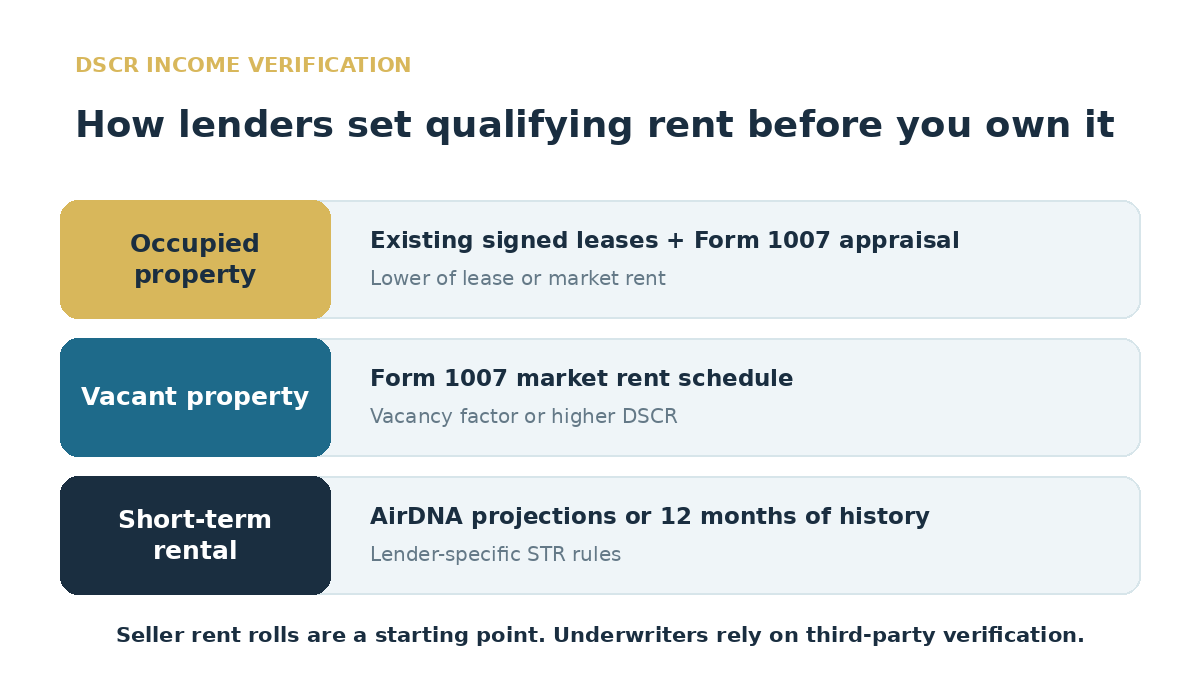
To determine qualifying rental income on a property the borrower does not yet own, DSCR lenders rely on standardized third-party verification methods rather than pre-closing bank deposits.
The Role of T-12 (Trailing Twelve Months) Documentation
When acquiring commercial or larger multifamily replacement properties (5+ units), underwriters routinely request a Trailing Twelve Months (T-12) operating statement along with current rent rolls. The T-12 documents actual historical collections, vacancy losses, and operating expenses over the prior year.
For 1-to-4 unit residential investment properties, lenders rely on Fannie Mae Form 1007 (Single Family Comparable Rent Schedule) or Form 1025 (Small Residential Income Property Appraisal Report). Independent appraisers inspect the property and analyze comparable neighborhood rentals to establish a fair market rent figure.
When Projected vs. Historical Income Enters the Picture
If a property is currently occupied under an active lease, the underwriter typically compares the lease rate against the appraiser's Form 1007 market rent estimate. Lenders generally qualify the file using the lower of the actual leased rent or the appraiser's market rent estimate:
- Actual Rent Below Market: If the existing lease is $2,000/month but the appraiser's market rent is $2,400/month, the lender usually qualifies the property at $2,000/month.
- Actual Rent Above Market: If the lease is $2,500/month but market rent is $2,100/month, the lender may cap qualifying income at $2,100/month unless the tenant demonstrates a long-term documented payment history.
Why Replacement Property Income Is Treated Differently
Lenders treat replacement property income differently because ownership transfer introduces execution risk. Existing leases may expire, tenants may default upon sale, or seller-provided rent rolls may contain inaccuracies.
By relying on independent appraisal rent schedules and verified estoppel certificates rather than pre-closing seller statements, DSCR underwriters protect the loan's security while ensuring the property can sustain debt service under new management.
3. The 1031 Exchange Timeline: Why Pre-Closing Income Complicates DSCR Qualification
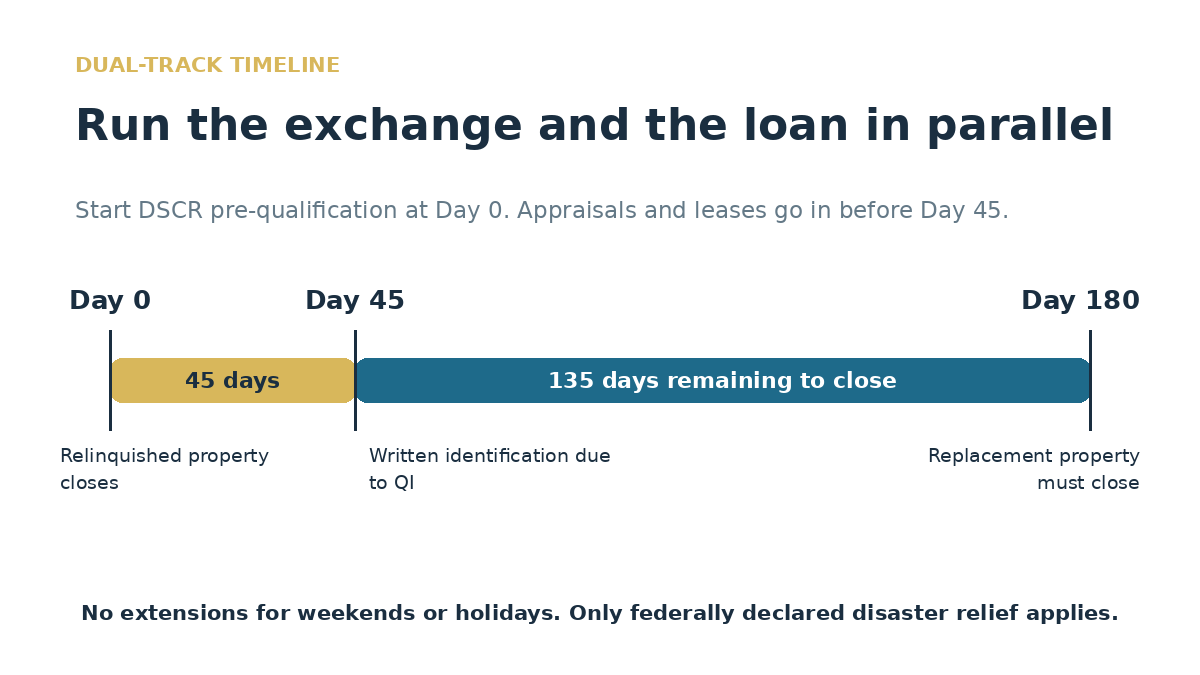
Combining DSCR loan underwriting with Section 1031 statutory deadlines creates a tight dual-track timeline. Investors must manage property identification and loan approval simultaneously.
The 45-Day Identification Window and Your Financing Clock
From the day the relinquished property closes, the investor has exactly 45 calendar days to identify potential replacement properties in writing to their Qualified Intermediary. Under the 3-Property Rule, most investors identify up to three potential assets.
If an investor identifies properties assuming high pre-closing rental income that a lender later haircuts during underwriting, the DSCR ratio may fall below the 1.15 threshold. If the 45-day window has expired, the investor cannot add alternative properties to their identification list.
The 180-Day Closing Deadline and Lender Approval Timelines
While 180 days seems generous, appraisal scheduling, lease estoppel collection, and title review can consume 30 to 45 days. If a DSCR lender rejects seller lease documentation on day 100, re-underwriting the loan under vacant property guidelines can delay closing past the 180-day deadline.
A missed 180-day deadline invalidates the 1031 exchange, triggering immediate capital gains tax liability, depreciation recapture, and potential state tax obligations on the relinquished property sale.
How x1031 Exchange Partners Help Navigate Financing Deadlines
Specialized platforms like x1031 Exchange help real estate investors and their realtors coordinate exchange milestone tracking with DSCR lender requirements. By aligning Qualified Intermediary documentation with specialized Non-QM mortgage brokers early in the transaction, investors ensure their replacement property underwriting is completed well before statutory deadlines approach.
4. Real-World DSCR Qualification Scenarios for Replacement Properties
To understand how DSCR lenders evaluate replacement property cash flow in practice, consider three common real-world acquisition scenarios.
Scenario 1: Acquiring an Occupied Property with Existing Tenant Lease
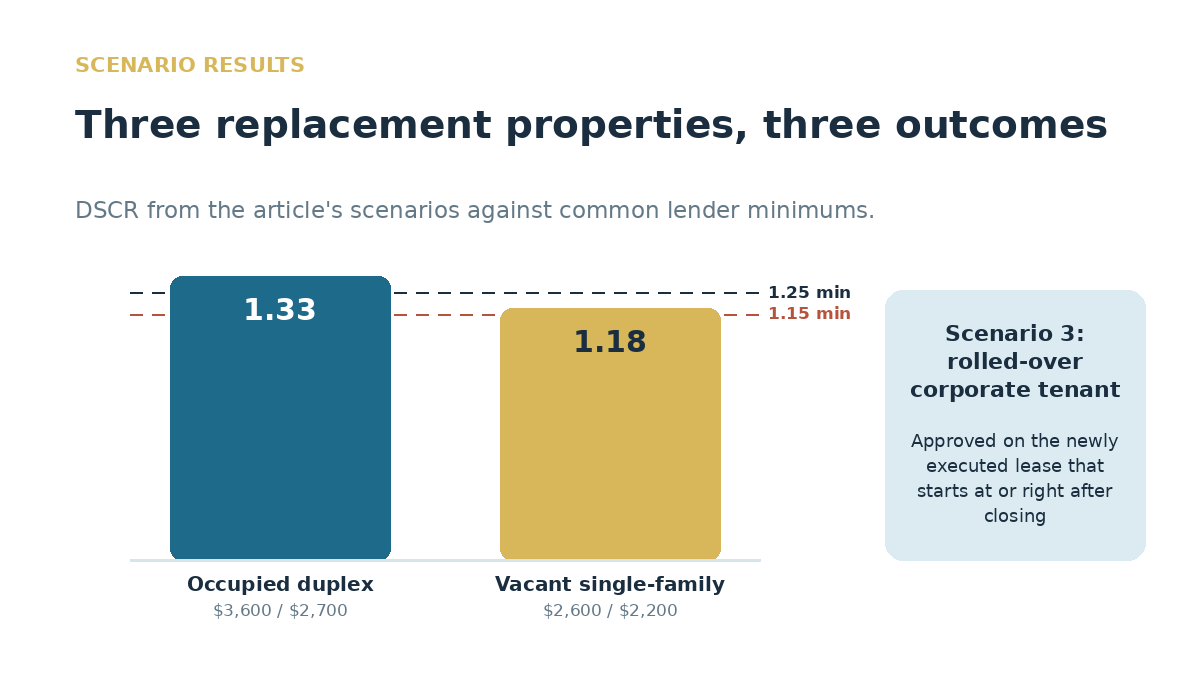
An investor identifies an occupied duplex producing $3,600 in total monthly rent ($1,800 per unit). The total monthly debt service on the new DSCR loan will be $2,700.
- Documentation Required: Executed tenant leases, proof of security deposit transfers, and an appraisal with Form 1007.
- Underwriting Outcome: The appraiser confirms market rent is $1,850 per unit ($3,700 total). The lender uses the lower actual lease figure of $3,600.
- DSCR Calculation: DSCR = $3,600 ÷ $2,700 = 1.33
- Result: Approved. The property easily exceeds the 1.25 DSCR threshold using verified existing lease rates.
Scenario 2: Purchasing a Vacant Property You Plan to Lease Immediately
An investor identifies a turnkey single-family rental that is currently vacant. The proposed DSCR loan payment is $2,200 per month.
- Documentation Required: Appraisal Form 1007 market rent schedule.
- Underwriting Outcome: The appraiser determines fair market rent is $2,600 per month. Because the property is vacant, most DSCR lenders apply a 5% to 10% vacancy factor or require a slightly higher DSCR threshold (e.g., 1.25 instead of 1.15).
- DSCR Calculation: DSCR = $2,600 ÷ $2,200 = 1.18
- Result: Approved under vacant DSCR guidelines, provided the lender accepts a 1.18 ratio for unleased residential properties.
Scenario 3: Rolling Your Own Tenant from a 1031 Sale Into the Replacement Property
An investor sells a commercial building where a long-term corporate tenant wishes to relocate into the newly acquired replacement property.
- Documentation Required: New corporate lease agreement executed prior to closing, corporate financial statements, and appraiser market rent schedule.
- Underwriting Outcome: The lender reviews the newly executed lease agreement. As long as the tenant's lease start date coincides with or immediately follows closing, the lender credits the full contract rent.
- Result: Approved based on the future executed lease agreement.
5. Common Mistakes Investors Make When Combining DSCR Loans with 1031 Exchanges
Navigating DSCR financing during a tax-deferred exchange requires avoiding several predictable pitfalls.
Assuming Pre-Closing Income Will Count (It Usually Won't)
The most frequent error is calculating DSCR coverage using unverified seller pro-forma statements or informal rent rolls. Investors who assume a lender will accept unverified seller claims often face sudden loan rejections when the formal appraisal Form 1007 arrives with lower market rent figures.
Underestimating How Long DSCR Loan Underwriting Takes
Although DSCR loans require less personal financial documentation than conventional agency mortgages, commercial property appraisals, rent schedules, and title reviews still require 21 to 35 business days. Waiting until day 40 of the 45-day identification period to submit a loan application compresses underwriting into a dangerous timeframe.
Not Pre-Qualifying for Financing Before Identifying Your Replacement Property
Identifying replacement properties without obtaining lender pre-approval creates severe structural risk. If the investor identifies three properties based on an assumed 80% Loan-to-Value (LTV) ratio, but the lender later limits coverage to 75% LTV due to DSCR constraints, the investor may lack the equity required to complete the purchase.
6. How to Position Yourself for DSCR Approval on Your Replacement Property
Investors can streamline DSCR underwriting and protect their 1031 exchange by taking proactive operational steps before making an offer.
Work with a DSCR Lender Experienced in 1031 Exchanges
Not all DSCR lenders understand the mechanics of 1031 exchanges. Experienced lenders know how to coordinate loan docs with the Qualified Intermediary, process assignment language in purchase agreements, and structure closing disclosures to reflect QI-held exchange funds without delaying funding.
Gather Documentation Early: Leases, Tax Returns, and Operating Statements
Request complete property documentation during the purchase contract inspection period:
- Fully Executed Leases: Include all amendments, renewals, and pet addenda.
- Tenant Estoppel Certificates: Signed statements from tenants confirming rent amounts, deposit holdings, and lease terms.
- Proof of Rent Deposits: Bank statements or ledger reports confirming actual tenant rent payments over the past 3 to 6 months.
Understand Your Required DSCR Ratio Before Making an Offer
Before submitting a purchase offer, calculate the property's projected DSCR ratio across conservative interest rate assumptions. Factoring in property taxes, landlord insurance, HOA fees, and required coverage margins ensures the deal remains viable even if interest rates shift during underwriting.
Common Questions
Frequently Asked Questions
A DSCR loan finances a 1031 exchange replacement property by qualifying the loan based on property cash flow rather than personal income. The lender calculates the Debt Service Coverage Ratio by dividing the property's gross monthly rental income by the total monthly debt service. During a 1031 exchange, the borrower coordinates loan documents directly with their Qualified Intermediary. Exchange proceeds held by the QI are applied directly toward the down payment and closing costs at settlement. The DSCR lender structures mortgage closing disclosures carefully to ensure full compliance with Internal Revenue Code Section 1031 tax-deferral rules, effectively protecting the real estate investor from unintended taxable boot liabilities or closing delays.
A Debt Service Coverage Ratio (DSCR) loan is a specialized business-purpose mortgage evaluated primarily on investment property cash flow rather than personal W-2 income or personal tax returns. Real estate investors frequently utilize DSCR loans for 1031 exchanges because they offer streamlined underwriting and flexible entity structuring options. Since conventional agency mortgages enforce strict personal income ratios and extended approval timelines, DSCR loans allow investors to close quickly within the rigid 180-day 1031 exchange completion window. Additionally, DSCR loans easily accommodate purchasing replacement properties within newly formed LLCs, partnerships, or corporate entities, perfectly matching the taxpayer entity requirements demanded by the IRS.
Yes, real estate investors can definitely use a DSCR loan to finance the acquisition of a replacement property in a 1031 exchange. IRS Section 1031 regulations permit obtaining new debt on replacement properties, provided the total purchase price and debt level meet or exceed the relinquished property's values to avoid taxable boot. When using a DSCR loan, the underwriter evaluates the target property's appraisal and rent schedule to confirm cash flow sufficiency. The borrower must notify their Qualified Intermediary early in the transaction so the purchase contract assignment and loan closing documents reflect the 1031 exchange structure accurately throughout escrow.
Most institutional Non-QM mortgage lenders require a minimum Debt Service Coverage Ratio between 1.15 and 1.25 for investment properties acquired through a 1031 exchange. A 1.25 DSCR means the property's gross monthly rental income exceeds monthly debt service by twenty-five percent. Some specialized DSCR loan programs offer financing for properties with a 1.00 ratio or even no-ratio options, though these programs typically demand lower Loan-to-Value thresholds or higher interest rates. Working with experienced mortgage professionals helps real estate investors identify lenders offering competitive terms aligned specifically with their replacement property's unique cash flow profile and 180-day exchange timeframe.
Savvy real estate investors combine DSCR loans with 1031 exchanges to defer significant capital gains taxes while scaling their rental portfolios through financial leverage. Cashing out a property sale triggers immediate capital gains taxes, depreciation recapture, and state tax liabilities, forfeiting up to thirty percent of net equity. By reinvesting exchange equity into a higher-value replacement property using a DSCR loan, investors preserve their capital, increase total portfolio cash flow, and build long-term wealth. DSCR financing provides the necessary debt leverage without requiring personal income verification or delaying the strict 180-day 1031 exchange closing timeline for real estate investors.
If a DSCR loan falls through near the 180-day deadline, the investor risks failing the 1031 exchange, making the transaction fully taxable. If the 45-day identification period has passed, the investor cannot swap replacement properties on their formal identification list. To mitigate this severe financial risk, experienced investors secure lender pre-approval before identifying properties, maintain backup financing options such as bridge loans or private capital, and select replacement assets with strong DSCR coverage margins. Working closely with Qualified Intermediaries like x1031 Exchange ensures early detection of potential financing bottlenecks before critical statutory deadlines expire in the exchange process.
Conclusion
Pre-closing rental income from a replacement property typically does not count as historical borrower income during DSCR qualification, but understanding how underwriters evaluate projected cash flow allows real estate investors to navigate financing smoothly. By relying on appraisal Form 1007 market rent schedules, gathering executed tenant leases early, and pre-qualifying for financing before statutory identification windows close, investors can secure competitive DSCR loans while protecting their capital gains tax deferral under Internal Revenue Code Section 1031.
Work with X1031 Exchange
To explore replacement property financing options, calculate your target DSCR coverage, or connect with experienced 1031 exchange professionals, visit x1031.com today.
Start Your Exchange →Disclaimer
DSCR loan terms, income calculation methods, and qualification requirements vary by lender and product type. Always verify specific terms with your loan officer and consult a qualified real estate attorney, CPA, or tax advisor regarding your individual 1031 exchange obligations.
Sources and official references
- Like-Kind Exchanges: Real Estate Tax Tips, Internal Revenue Service
- 26 U.S. Code § 1031, Exchange of Real Property Held for Productive Use or Investment, Cornell LII
- 26 CFR § 1.1031(k)-1, Treatment of Deferred Exchanges, Cornell LII
- General Rental Income Information (B3-3.1-08), Fannie Mae Selling Guide
- DSCR Loans, Bond Street Mortgage