REALTOR 1031 EXCHANGE GUIDE
1031 Exchange for Real Estate Agents: A Realtor's Guide
Imagine closing a $1.2 million commercial listing for an investor client, only to watch them lose nearly $300,000 in combined federal capital gains, net investment income, and state taxes. Worse yet, imagine discovering six months later that your client took their next three replacement property purchases to another agent who proactively brought a tax-deferral strategy to the table. For real estate professionals, recognizing a tax-deferred transaction before a purchase agreement goes live is the difference between being a standard order-taker and becoming an indispensable trusted advisor. Mastering the mechanics of Section 1031 allows agents to guide clients through complex sales, protect transactional timelines, and generate double the commission volume by handling both the sale of the relinquished property and the purchase of replacement assets.
IN THIS GUIDE
What every agent should know before the listing goes live
Explain it clearly
A client-ready way to describe a 1031 exchange without crossing into tax or legal advice.
Track the deadlines
The 45-day identification and 180-day exchange periods, and what a missed date costs.
Use it yourself
How agents apply 1031 exchanges to their own portfolios, with the tax-deferral math.
What Is a 1031 Exchange and Why Realtors Need to Understand It
Definition and basic mechanics
A 1031 exchange, governed by Section 1031 of the Internal Revenue Code, allows real estate investors to defer paying capital gains taxes and depreciation recapture when selling an investment or business property, provided they reinvest all net proceeds into a qualifying "like-kind" replacement property. The core underlying mechanism relies on continuity of investment: rather than cashing out equity and triggering a taxable event, the property owner rolls the full capital stack into new real estate. To preserve tax-deferred status, the taxpayer must adhere to strict statutory guidelines, including transferring property rights through a Qualified Intermediary (QI) and maintaining or increasing total debt and equity in the replacement property to avoid taxable "boot."
How it differs from other real estate transactions
Standard real estate transactions follow a linear closing process where seller proceeds flow directly from escrow or settlement into the seller's bank account upon funding. In a 1031 exchange, constructive receipt of funds by the taxpayer immediately invalidates the exchange and renders all gains fully taxable. Consequently, an independent third party—the Qualified Intermediary—must hold the sale proceeds in a segregated escrow account and acquire the replacement property on behalf of the client. Furthermore, while conventional deals allow buyers flexible timelines to shop for property, 1031 exchanges impose rigid, non-extendable federal statutory deadlines from the exact day the relinquished property closes.
Why this knowledge protects your clients and your reputation
Real estate agents who understand 1031 exchanges protect their clients from catastrophic tax liabilities while safeguarding their own professional reputation and liability. When an agent spots an exchange opportunity early during pre-listing discovery, they can ensure appropriate contract contingency language is added before signature, preventing accidental closing delays or missed Qualified Intermediary engagement. Agents who fail to flag exchange possibilities risk client dissatisfaction, lost repeat business, and potential legal claims if a client suffers preventable tax exposure due to improper contract structuring or missed coordination timelines.
How to Explain a 1031 Exchange to Your Real Estate Clients
Simplifying the concept without losing accuracy
Explaining complex tax strategies to clients requires clear, actionable framing without stepping into unauthorized legal or tax advice. A practical script for agents is: "A 1031 exchange lets you sell your current investment property and roll 100% of your equity and debt into a new investment property without paying capital gains tax today. Think of it as an interest-free loan from the government that keeps your capital working for you at full compounding power." Emphasize to clients that a 1031 exchange is a tax-deferral mechanism rather than a tax-elimination loophole, preserving capital for wealth accumulation while maintaining full legal compliance.
Common client questions and clear answers
Clients frequently ask whether they can pull cash out during the closing or buy a cheaper replacement property. You can explain that taking cash out or reducing total debt creates taxable "boot," which triggers capital gains tax on the difference. Another common inquiry is whether "like-kind" requires swapping the exact same property type—such as a single-family rental for another single-family home. Agents can clarify that "like-kind" refers to the investment intent rather than property class, allowing an investor to exchange a single-family rental for a multi-family apartment building, commercial retail strip, or industrial warehouse.
When to recommend involving a qualified intermediary or tax professional
The cardinal rule for real estate agents is to introduce a Qualified Intermediary and CPA before any purchase agreement becomes binding or escrow closes. Once closing funds are wired to a client's personal account, the 1031 exchange is legally dead and cannot be cured retroactively. Agents should maintain a clear professional boundary by providing educational insights while directing specific tax calculations, legal drafting, and exchange execution to qualified professionals. Introducing the Qualified Intermediary early in the transaction guarantees that exchange documentation, assignment clauses, and escrow instructions are fully coordinated prior to closing day.
Critical 1031 Exchange Deadlines Realtors Must Know
The 45-day identification period
The moment the relinquished property closes escrow and deeds transfer, the statutory 45-day identification clock begins ticking. By midnight of the 45th calendar day, the investor must formally submit a written, signed identification of potential replacement properties to the Qualified Intermediary. This deadline is strictly calendar days—weekends and legal holidays do not extend the timeframe. Investors typically utilize one of three statutory identification rules: the 3-Property Rule (identifying up to 3 properties of any value), the 200% Rule (identifying any number of properties as long as total fair market value does not exceed 200% of the sold property), or the 95% Rule (identifying any number of properties, provided at least 95% of the total value identified is ultimately purchased).
The 180-day exchange period
In addition to the 45-day identification window, the entire 1031 exchange must be completed within 180 calendar days of the relinquished property's closing, or by the tax return due date for the year of transfer (whichever comes first). The 45-day identification period runs concurrently with the 180-day timeline, meaning investors have exactly 135 remaining days after the identification cutoff to negotiate, underwrite, secure financing, and close on their replacement property. Because 180 days pass rapidly in competitive real estate markets, proactive real estate agents begin sourcing replacement property options well before the relinquished property closes.
What happens if your client misses these deadlines (and your liability)
Failing to meet either the 45-day identification deadline or the 180-day completion cutoff results in total disqualification of the exchange by the IRS. The investor immediately faces full tax recognition on all accumulated capital gains, state taxes, and depreciation recapture. For the real estate agent, failing to track these deadlines or allowing closing delays without proper contract contingencies can destroy client trust and result in professional liability claims. Agents protect themselves by maintaining clear written communication, setting automated calendar tracking for key deal dates, and explicitly directing clients to coordinate timeline enforcement with their Qualified Intermediary.
Qualifying Properties and What Your Clients Can Exchange
Which property types qualify
To qualify for Section 1031 tax deferral, both the sold property (relinquished) and the purchased property (replacement) must be held for productive use in a trade, business, or for investment purposes. Due to the broad definition of "like-kind" real estate, qualifying property types include single-family rental homes, multi-family apartment complexes, commercial office buildings, industrial flex spaces, retail centers, agricultural land, and mineral rights. Investors can freely diversify or consolidate portfolio assets—for example, exchanging four residential rental units into a single triple-net (NNN) commercial property.
Which property types do NOT qualify
Section 1031 explicitly excludes primary personal residences, secondary vacation homes used exclusively for personal enjoyment, properties held primarily for sale (such as fix-and-flip inventory or developer land flips), and financial assets like stocks, bonds, partnership interests, or REIT shares. Furthermore, personal property and machinery no longer qualify following tax law changes under the Tax Cuts and Jobs Act. Real estate agents assisting clients with mixed-use assets or property flippers must carefully distinguish between investment hold properties and inventory flip properties to prevent IRS audit exposure.
How to verify property eligibility before promising a 1031 exchange
Before marketing a property as a 1031 exchange candidate or writing an offer on a replacement asset, agents should conduct a thorough discovery screening with the client. Review tax reporting history, hold period duration, and lease agreements to ensure the property demonstrates bona fide investment intent (typically evidenced by a minimum hold period of 12 to 24 months). Agents must verify ownership entities to confirm that the taxpayer selling the relinquished property matches the taxpayer purchasing the replacement property. Always include a disclaimer stating that final eligibility verification must be confirmed by the client's CPA or tax attorney.
Building Your Own Real Estate Investment Portfolio With 1031 Exchanges
How realtors use 1031 exchanges personally
Real estate agents are uniquely positioned to build long-term generational wealth by applying 1031 exchange strategies to their personal investment portfolios. By leveraging commission earnings to acquire initial investment properties, agents can systematically upgrade assets over time without tax friction. For example, an agent can trade a modest duplex into a quadplex, and later exchange that quadplex into a commercial strip center. By deferring tax on each transaction, 1031 exchanges allow real estate agents to compound 100% of their equity growth, rapidly expanding their net worth and passive rental income stream.
Tax deferral benefits and calculating potential savings
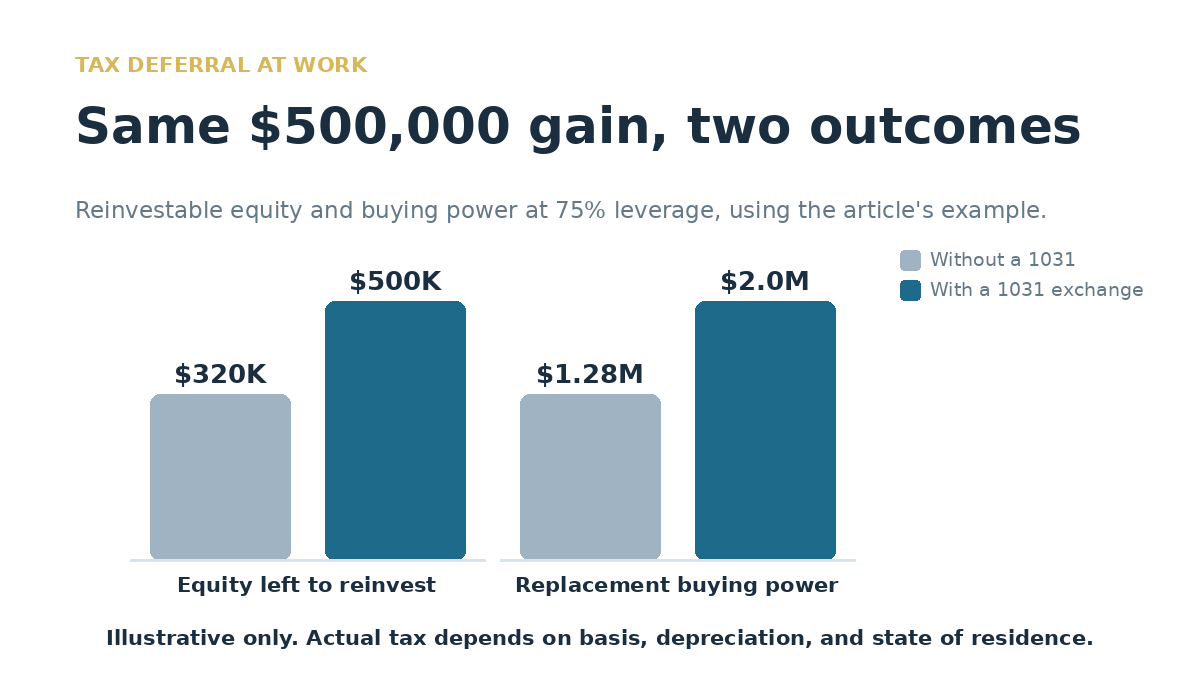
The financial compounding effect of tax deferral is extraordinary. When selling an investment property with $500,000 in taxable gain, an investor typically faces a 20% federal capital gains tax, a 3.8% Net Investment Income Tax (NIIT), depreciation recapture tax at 25%, plus applicable state capital gains taxes (which can exceed 10% in states like California or New Jersey). Without a 1031 exchange, over $180,000 of the $500,000 gain is lost to taxes, leaving only $320,000 to reinvest. By executing a 1031 exchange, the agent retains the full $500,000, allowing them to purchase up to $2,000,000 in replacement property using 75% leverage, compared to just $1,280,000 without tax deferral.
Common mistakes realtors make (and how to avoid them)
The most frequent mistake agents make when executing personal 1031 exchanges is taking cash out of closing funds to pay personal expenses or tax obligations, inadvertently generating taxable boot. Another common error is underestimating debt replacement requirements: if the sold property had a $400,000 mortgage, the replacement property must have at least $400,000 in new debt (or additional cash injected) to prevent mortgage boot. Real estate agents can avoid these pitfalls by working directly with a Qualified Intermediary early, structuring purchase agreements with proper 1031 exchange assignment addendums, and strictly maintaining matching taxpayer entities throughout the transaction.
Why Investors Choose 1031 Exchanges and the Cost of Ignoring Them
The real tax savings numbers
Investors consistently choose 1031 exchanges because tax deferral dramatically accelerates portfolio growth and internal rates of return (IRR). Consider an investor who turns over real estate assets every seven years over a 28-year investment horizon. Compounding wealth through four tax-deferred 1031 exchanges yields more than double the net worth of an un-deferred portfolio that pays capital gains tax on every sale. Furthermore, under current tax law, holding 1031 assets until death provides heirs with a stepped-up tax basis, effectively eliminating cumulative deferred capital gains taxes entirely—a strategy widely known as "swap, till you drop."
The reputational and legal risk of not informing clients
Failing to discuss 1031 exchange options with investment property sellers creates severe reputational damage and exposure to client grievances. If an investor client sells a rental property and later realizes they could have deferred six figures in taxes had their agent mentioned Section 1031, that client will inevitably sever the business relationship and share their negative experience within their investor network. Educating clients on tax-deferred options demonstrates advanced real estate expertise, builds lasting client loyalty, and secures representation on both the sell-side and buy-side of exchange transactions.
How x1031 Exchange can support your 1031 knowledge and client success
Navigating complex 1031 exchange rules requires access to reliable educational tools, transaction calculators, and expert Qualified Intermediary coordination. Platform resources like x1031 Exchange empower real estate agents with step-by-step transaction guides, timeline management tools, and client-facing educational materials. By partnering with x1031 Exchange, agents gain the institutional knowledge needed to guide clients confidently through identification rules, debt replacement calculations, and closing logistics, ensuring every exchange transaction closes smoothly, on time, and in full compliance.
Conclusion
Understanding Section 1031 exchanges is an essential strategic skill for real estate agents looking to elevate their business and serve investment clients effectively. By mastering exchange timelines, property qualifications, and Qualified Intermediary coordination, real estate agents can protect client equity, prevent costly tax errors, and capture dual-transaction commissions on both sale and replacement properties. Incorporating 1031 exchange knowledge into your client advisory process builds long-term professional credibility and positions you as a premier market expert. Partnering with educational platforms like x1031 Exchange equips you with the tools needed to streamline complex deals and scale your real estate practice.
Common Questions
Frequently Asked Questions
A 1031 exchange is a tax-deferral mechanism under Section 1031 of the Internal Revenue Code that allows real estate investors to defer paying capital gains tax and depreciation recapture when selling an investment property, provided they reinvest all net proceeds into a qualifying like-kind replacement property. For real estate agents, understanding this process creates a high-value opportunity to represent clients on both the sale of their relinquished asset and the subsequent acquisition of replacement real estate. Real estate agents serve as essential deal coordinators during an exchange, ensuring purchase contracts contain proper 1031 assignment language, key statutory deadlines are tracked, and an independent Qualified Intermediary is formally engaged prior to escrow closing.
You can explain a 1031 exchange to clients as an interest-free loan from the government that keeps 100% of their equity working at full compounding power. Explain that when selling an investment property, capital gains taxes normally consume up to 30% or more of their net profits. By executing a 1031 exchange, they roll the full sale proceeds into a new replacement property without paying capital gains tax today. Emphasize that funds must be handled by an independent Qualified Intermediary rather than touching personal bank accounts, and that "like-kind" rules allow flexibility to swap property classes, such as trading a residential rental for a commercial retail building, provided both are held for investment.
A 1031 exchange involves two strict, non-extendable statutory deadlines that begin the exact day the relinquished property closes escrow. First, the client has exactly 45 calendar days to formally identify potential replacement properties in writing to the Qualified Intermediary. Second, the client must acquire and close on the replacement property within 180 calendar days of the original closing (or by their tax return filing due date). Weekends and legal holidays do not extend these windows. If a client misses either deadline by even one day, the 1031 exchange is fully disqualified by the IRS, rendering all capital gains, depreciation recapture, and applicable state taxes immediately due.
To qualify for a 1031 exchange, both the sold property and the replacement property must be held for productive use in a trade, business, or for investment purposes. Qualifying real estate includes single-family rental homes, multi-family apartment buildings, commercial retail centers, office buildings, industrial flex spaces, agricultural farmland, and vacant land held for appreciation. Properties can be exchanged across different real estate categories anywhere within the United States. However, primary personal residences, secondary vacation homes used exclusively for personal enjoyment, fix-and-flip properties held primarily for quick resale, corporate stock, partnership interests, and personal property do not qualify under current Section 1031 tax regulations.
An investor can defer up to 100% of their total tax liability by reinvesting all net sale proceeds and acquiring equal or greater debt on the replacement property. Combined tax liabilities typically range from 25% to 40% of the net taxable gain, comprising federal capital gains tax (up to 20%), Net Investment Income Tax (3.8%), depreciation recapture tax (25%), and applicable state capital gains taxes. For example, on a $500,000 net gain, tax savings can easily exceed $150,000 to $180,000 in immediate capital preserved. Deferring these taxes allows real estate investors to leverage their full equity stack into purchasing larger, higher-performing replacement properties.
The most dangerous mistake real estate agents make is failing to involve an independent Qualified Intermediary before closing escrow on the relinquished property. If the seller receives sale proceeds directly into their bank account, constructive receipt invalidates the exchange permanently. Other frequent errors include failing to insert proper 1031 exchange contingency and assignment clauses into purchase agreements, miscalculating the strict 45-day and 180-day deadlines, and overlooking debt replacement requirements that trigger taxable mortgage boot. Real estate agents also risk severe liability by attempting to offer formal legal or tax advice rather than referring clients to qualified CPAs, attorneys, and Qualified Intermediaries.
Ready to master 1031 exchanges and offer expert guidance to your real estate clients?
Visit x1031.com to access free 1031 exchange calculators, downloadable transaction checklists, and educational resource hubs designed specifically for real estate agents and investors. Whether you are helping a client structure a complex transaction or planning your next personal investment, x1031 Exchange provides the tools and expert support you need. Schedule a consultation or explore our real estate professional hub today to turn tax-deferred exchanges into a primary driver for your real estate practice.
Start your client's exchange →Disclaimer
This article is provided for educational and informational purposes only and does not constitute legal, tax, or financial lending advice. 1031 exchange rules are complex and subject to change. Real estate agents and investors should always consult a licensed Qualified Intermediary, tax professional, certified public accountant, or real estate attorney regarding individual transaction structuring and tax strategies.