Return on investment, often called ROI, is a general term used to compare a property’s income, costs, and cash invested. A clear review starts with records that support each item.
This article explains common terms and records in plain language. It does not estimate an outcome or recommend a property, loan, price, or transaction. It is general property information only.
In This Guide
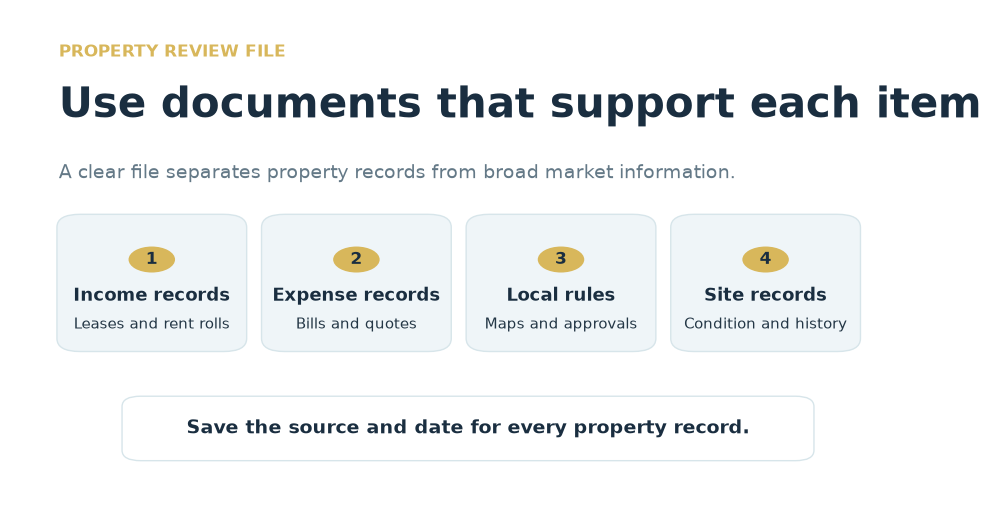
Three records that support a clear property review
Income records
Keep lease terms, rent records, and other documented property income.
Expense records
Keep bills and quotes for recurring operating costs.
Property records
Keep local rules, approvals, condition records, and current documents.
What ROI means in a property discussion
ROI is a broad term. In property discussions, people may use it to describe several different measures. The key is to state which measure is being used and which records support it.
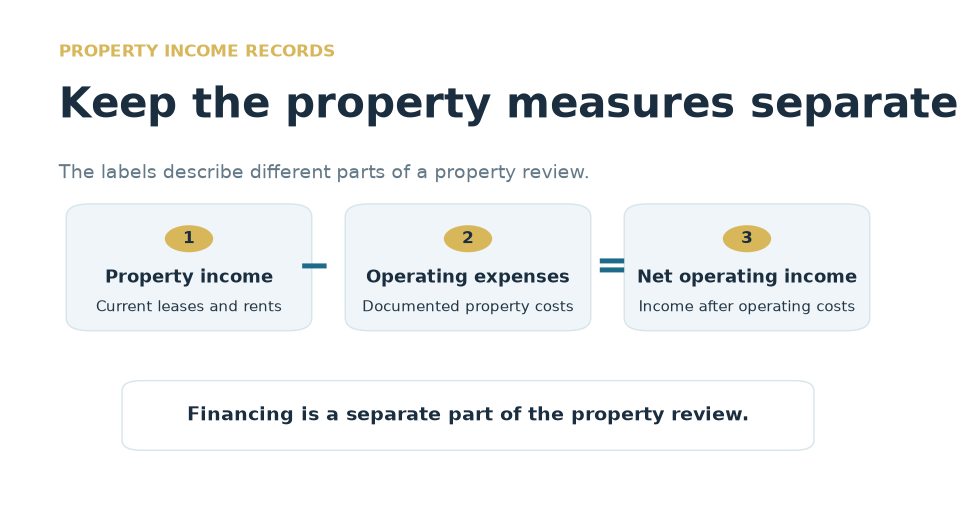
Net operating income, or NOI, is a common starting point. It describes property income after operating expenses and before financing or income taxes. It is different from the amount of cash a person may receive after a loan payment.
Cap rate, cash flow, and debt coverage describe different parts of a property review. They should not be treated as interchangeable labels.
Keep property income, operating expenses, and financing information separate when describing the records. [1]
Which records support property income
Income records can include current leases, rent rolls, payment history, and written information about other property income. The source and date should be saved with each record.
Do not treat a listing claim as a complete income record. A current lease, a rent roll, or another reliable document is more useful for understanding the property’s actual information.
For a property with units that are vacant, under renovation, or offered at a new rent, label those items clearly. They are not the same as current collected income.
Which records support operating expenses
Operating expenses are the costs used to run and maintain the property. They can include property insurance, management, utilities paid by the owner, repairs, maintenance, and local charges.
Keep a current bill, service agreement, or written quote for each major expense. The details matter because building age, condition, services, and location can change the cost for one property.
Institutional underwriting guidance also emphasizes reliable property information and documentation. It can provide useful context, but it does not replace a review of the specific property file. [2]
Why local property rules matter
Local rules can affect a property’s use, layout, required approvals, and operating requirements. A proposed change to a building can raise different questions than the property’s current use.
For a Jersey City address, the Division of Zoning is an official starting point for current zoning information and process guidance. [3]
Keep zoning maps, approval records, permits, and relevant City information with the main property file. They help show what is documented for the specific site.
A clear property review uses current income records, expense records, local rules, and site information together.
How to use market information carefully
Market reports can provide broad context for rent, vacancy, and commercial conditions. They are helpful for understanding a larger area, but they do not replace property-level records.
Jersey City includes many distinct areas and building types. A regional figure may not describe one building, one block, or one set of lease terms. Use the source date and coverage area when reading any market report.
The National Association of REALTORS® Commercial Real Estate Metro Market Dashboard is one source for broader market context. [1]
Questions for a qualified professional
Ask which income and expense records are needed to review the specific property. Ask what information is missing, dated, or based on an estimate rather than a current document.
Ask how zoning, permits, legal use, condition, financing, valuation, and local rules may apply to the property. Different questions may need different qualified professionals.
Ask for an explanation of the assumptions and limits used in any property analysis. Clear records make that conversation more useful.
Sources
Sources for further verification
Use current official and institutional sources when reviewing a specific property or local process.
Net operating income is property income after operating expenses and before financing or income taxes. It is a property-level measure, not a personal tax calculation.
No. These terms can describe different measures. A clear discussion identifies the measure and the records used to support it.
Keep current income records, expense records, site records, local rules, permits, and any relevant approvals together. Save each source and date.
Not by itself. A market report can provide broader context, while property-level documents are more useful for a specific building or block. [1]
Considering a Sale?
Talk to X1031 Exchange Before Your Closing
Contact X1031 Exchange to learn about the company’s services. For tax, legal, financial, zoning, or real estate advice, work with your own qualified professionals.